

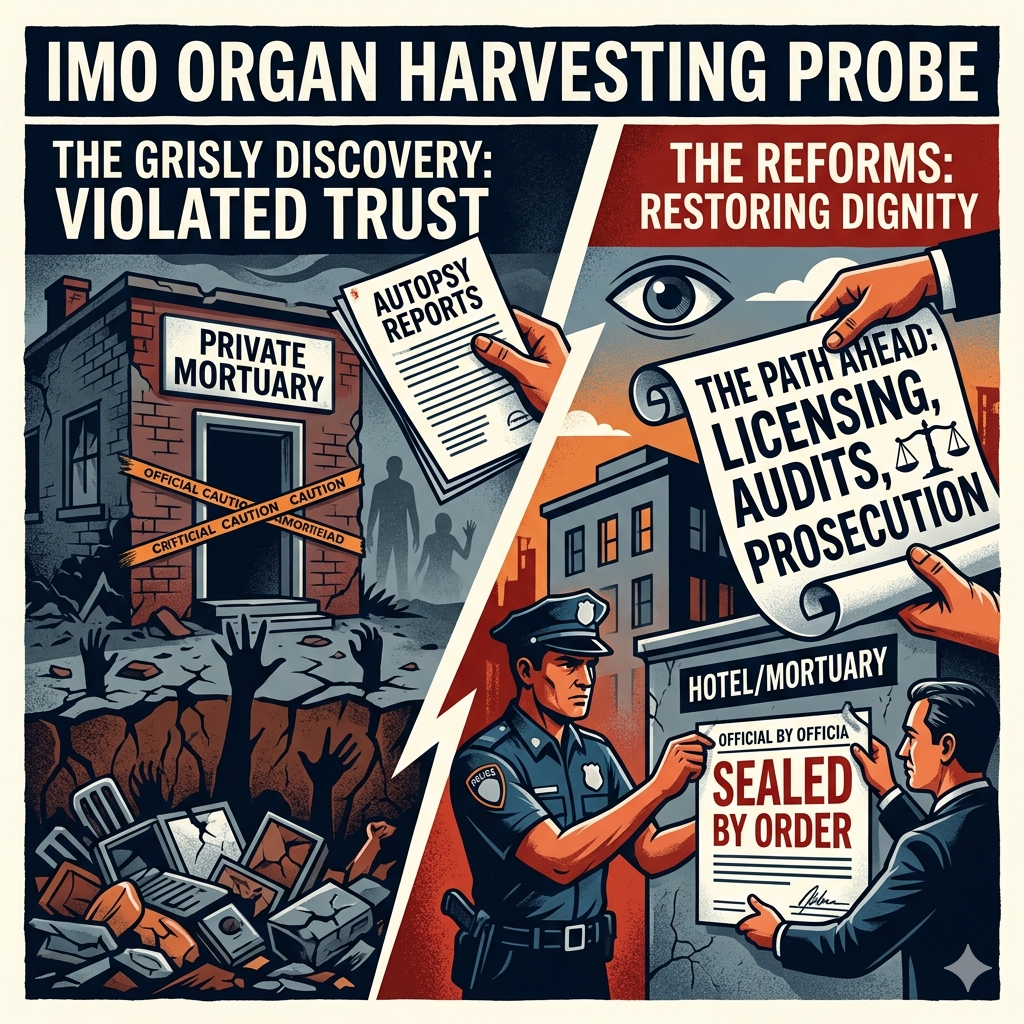
The sight of a mortuary — cold slabs, white sheets, a quiet corridor where families once whispered prayers — should make a community breathe slower, bow a head, and remember. In recent weeks, however, parts of south-east Nigeria have been jolted by grisly discoveries that turned that quiet into outrage. Police in Imo State sealed a private mortuary and a hotel after a raid uncovered dozens of decomposed and mutilated corpses, prompting a probe into an alleged organ-harvesting ring. The state even began demolition of properties linked to the case as security agencies hunt suspects.
What these reports exposed is more than a single criminal enterprise: they exposed holes in regulation, gaps in policing, and a social trust so frayed that people now fear that the place that should protect the dignity of the dead could be turned into a slaughterhouse for the living. The Imo discoveries sit uneasily beside earlier, high-profile convictions abroad that showed Nigeria’s organ-trafficking problem can reach into elite circles — a reminder that the trade is not only brutal but transnational.
This feature asks: what went wrong, who should be held to account, and — crucially — what practical steps will prevent private mortuaries from becoming the infrastructure of organ theft?
How it happened (the short version)
Security operations along the Owerri–Aba highway and in Ngor-Okpala — a response to rising attacks on travellers — led officers to follow suspicious movements that culminated in the discovery and sealing of a mortuary and hotel suspected of links to kidnapping and organ trafficking. Local authorities say the operation uncovered large numbers of bodies in a private facility, triggering an ongoing police probe and demolition of structures believed to be criminal hubs.
(There are dramatic local accounts circulating on social media — some unverified — claiming victims were presented as dead when they were alive, or that people ‘escaped’ from mortuaries. Those claims need careful forensic verification. Reckless repetition of unconfirmed details will do victims and justice a disservice.)
Why private mortuaries can become dangerous
Private mortuaries, like other private providers, fill a genuine service gap. But where regulatory oversight is thin, the profit motive combined with criminal enterprise becomes toxic. The risk factors are straightforward:
Low barriers to entry. If registration and inspection are perfunctory, anyone can open a facility.
Opacity in the chain of custody. Poor documentation makes it easy to conceal where bodies came from and how they left.
Weak interagency coordination. Health ministries, police, environmental health officers and local governments are often not sharing data or inspections.
Corruption or collusion. Where officials are bribed or intimidated, illegal networks flourish.
Demand for organs. A market — local, regional or international — creates incentive for criminal actors to supply organs by violent means. The problem becomes transnational when organs are trafficked for transplants abroad or when the networks include medical professionals willing to bypass ethics and law.
Should private mortuaries be banned?
Short answer: No — not across the board. Closing legitimate private operators would hurt families and overwhelm public facilities. But: a temporary moratorium on new private mortuary licences until a full, transparent audit and tougher regulatory framework is in place is a sensible emergency move. Existing operators should be audited immediately; those that fail basic standards must be shut down and prosecuted.
That balance — not an ideological ban but an enforcement-heavy pause — protects public interest without throwing out legitimate service providers.
Practical, implementable reforms to stop organ harvesting
Below are specific, actionable measures that governments, regulators and communities can implement now.
1) Tighten licensing and accreditation (make the process meaningful)
Require professional certification for mortuary managers (medical training + mortuary sciences).
Mandate criminal background checks and periodic re-vetting for owners, managers and staff.
Require a performance bond or insurance (forfeitable on conviction) so assets can be seized quickly.
Publish an online registry of licensed mortuaries (location, license number, inspection dates) so families can verify.
2) Chain of custody and documentation — make every body traceable
Standardize and digitalize an electronic chain-of-custody form for every body, with timestamps at each handover (police, hospital, mortuary, family).
Require ID verification (biometrics or at least official ID) and a signed release for every transfer.
Create penalties for falsifying forms — not only for mortuary staff but for any official who assists.
3) Inspections, CCTV and transparency
Mandate CCTV in work and holding areas, with encrypted offsite streaming to the state health ministry or police evidence unit. Cameras must be tamper-proof and logs retained for a legally specified period.
Hold unannounced inspections by multi-agency teams (health, police, environment, and local government). Publish inspection results publicly.
For suspicious sites, allow forensic auditors immediate access and preserve scenes for proper investigation.
4) Strengthen laws and punishments
Create clear offences for organ trafficking, wilful concealment of bodies, and operation of unlicensed mortuaries, with mandatory long prison terms (e.g., 10–25 years) and heavy fines plus asset forfeiture for organisers.
Add aggravated penalties for crimes involving minors, vulnerable persons, or collusion with public officials.
Fast-track prosecution for organ-trafficking cases: specialised court lists or dedicated prosecutors so cases don’t languish.
5) Protect whistleblowers and informants
Set up secure, anonymous tip lines (toll-free and online) with witness protection options. Reward credible tips that lead to convictions.
Guarantee immunity or mitigation for insiders who cooperate and provide evidence.
6) Community engagement and family protocols
Public education: families must insist on paperwork, receive receipts, and be advised to accompany bodies to mortuaries or choose licensed alternatives.
Religious and community leaders should be trained to verify mortuary licences and urge congregations to demand transparency.
Encourage local media and CSOs to monitor mortuary operations and publish audits.
7) Cross-border and healthcare safeguards
Strengthen port, airline and hospital checks for illicit organ movements. Build protocols with hospitals to report suspicious transplant requests. High-profile international prosecutions (such as the Ekweremadu case in the UK) show how organ-trafficking networks can cross borders — domestic action must link to international law enforcement.
An immediate, pragmatic roadmap for state governments (three steps)
- Emergency audit & moratorium: publish the audit criteria, freeze new licences for 60–90 days, and immediately suspend licences for facilities under credible investigation.
- Create a joint task force: pair the health ministry with police, anti-trafficking agencies and civil society to coordinate arrests, prosecutions and policy changes. (The recent joint security patrols along Owerri–Aba should be expanded to include a permanent intelligence strand that monitors suspected facilities.)
- Legislative push: pass emergency regulations that require CCTV, digital chain-of-custody, and minimum staffing/qualification standards — with clear penalties and asset seizure provisions. Use the high publicity of recent raids to build political will.
What punishment should offenders face?
The crimes we’re describing are brutal and often amount to modern-day slavery and murder. Penalties should reflect that severity:
Long custodial sentences (10–25 years or life where murder is proven).
Large fines proportionate to the profit from the crime, plus forfeiture of property used in the offence.
Professional bans: lifetime ban from healthcare or mortuary work for convicted staff.
Civil remedies: mandatory compensation fund for victims’ families, financed by fines and bonds paid by licensed mortuaries.
Prosecution of complicit officials with the same weight as other offenders.
How I feel — and what society must feel
These stories provoke anger, revulsion and grief – emotions that must translate into action, not only outrage. The mortuary is a public trust. Turning it into a site of predation is an assault on the social contract: our dead are supposed to bind families and communities together in mourning, not become commodities. The state, religious leaders, medical bodies and civil society must reclaim this trust together.
Final plea: make dignity a measurable standard
Dignity isn’t just a moral idea; it can be encoded into law and practice. Require licensure to be meaningful, inspections to be public, and penalties to be real. Empower families with clear, simple steps — always demand paperwork; never allow strangers to take a body without documented authority, and report suspicious mortuaries immediately. Communities that refuse to be silent will starve criminal networks of the cover they need.