

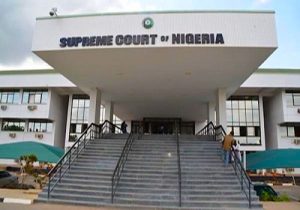
Nigerian Bar Association (NBA) has asked its eligible members to apply for the six vacancies on the Supreme Court bench as recently announced by Chief Justice of Nigeria (CJN) Tanko Muhammad.
PREMIUM TIMES reported that Mr. Muhammad, in accordance with the relevant rules, had sent letters requesting nominations to fill the six NBA positions and other relevant judicial officials, chiefs of courts, among others.
The CJN letter indicates that the six available positions will be filled by candidates from five of Nigeria’s six geopolitical zones.
Appointment of lawyers from the bar association directly to the bench of the Supreme Court is rare in Nigeria, even though it is backed by the constitution.
What has become the norm, however, is to preserve Supreme Court appointments only for Court of Appeals judges.
But this new call from the NBA for the nomination of lawyers to fill the vacancies on the highest court in Nigeria is not the first.
In 2017, some accomplished lawyers from around the country were nominated by the NBA for appointment to the bench of the Supreme Court. The nominations were never approved.
Walter Onnoghen, a former CJN, similarly to his successor, Mr. Muhammad, had written to the NBA, requesting that it nominate eligible members of the Bar for consideration in the high court.
Former Chief Justice of Nigeria, Walter Onnoghen
In response, then-NBA president Abubakar Mahmoud, a leading Nigerian lawyer, submitted the names of nine eligible candidates to then-acting CJN and Federal Judicial Service Commission (FJSC) chairman Mr. Onnoghen for review. appointment as judges of the Supreme Court. Cut.
The nominated attorneys were: Former NBA President Olisa Agbakoba (SAN), Anthony Ikemefuna Idigbe (SAN), Yunus Ustas Usman (SAN), Babatunde Fagbohunlu (SAN), Miannaya Aja Essien (SAN), Awa Uma Kalu (SAN), Professor Awalu Hamish Yadudu, Tajudeen Oladoja and Ayuba Giwa.
According to the NBA, the shortlist followed a rigorous selection process conducted by a committee chaired by Mr. Mahmoud (SAN), with eight other eminent lawyers as members.
However, the nominees, who include lawyers and academics from the legal profession, never made it to the Supreme Court, an issue Mr. Agbakoba raised at a recent NBA Justice Summit in Abuja.
Lawyers at the summit were unanimous in calling for reforms in the justice sector, particularly in the appointment of judges.
Why didn’t the appointment with the lawyers take place?
Mr. Agbakoba reminded CJN’s representative at the event, Supreme Court Justice John Okoro, how the exercise, which was intended to transform the delivery of justice on the high court, had been cut short.
“My Lord, you know that I was one of the lawyers who were nominated for the position in the Supreme Court,” said Mr. Agbakoba.
A former president of the Nigerian Bar Association (NBA), Olisa Agbakoba
“But that exercise never took place,” the former NBA president said in making his remarks at the technical session of the justice summit in January in Abuja.
In his response, Mr. Okoro said that the appointment of judicial officers used to be a “secret” exercise due to the conservative nature of the judiciary.
“Judges approached prominent lawyers for court appointments, and most of them refused such offers,” explained Mr. Okoro.
“However, these days, the judge appointment process has become very competitive. If there are vacancies for appointment to the caucus, there are judges who are already in the system. So how do you go out and find people (lawyers) to come in?” Okoro wondered as he answered Agbakoba.
Opposition to directly appointing lawyers to the Supreme Court comes mainly from judges, who see it as a threat to their career advancement.
This school of thought sees it as unfair that lawyers, who disdained joining the court from the lowest rungs, are rewarded with the highest court in the land to the detriment of the chances of the lower court judges who made the early decisions of pursue the charge. judicial career with the hope of gradually ascending to the Supreme Court one day.
He also argues that such a development would rob experienced Court of Appeals judges of the opportunity to be elevated to the higher court, adding that “competent lawyers,” mostly SANS, “cannot have the best of both worlds: the bar and work table.”
Many have also argued that it would cause instability on the Supreme Court and cause unnecessary disaffection among the court’s judges and within the judiciary in general.
advertisements
But those who advocate appointing Supreme Court justices directly from the bar, including academic lawyers, say it will broaden the court’s much-needed diversity of thought and expertise.
Criteria for the appointment of the Supreme Court
To be eligible for the bench of the Supreme Court, the applicant must be a lawyer of not less than 15 years. The same applies to whoever is appointed Chief Justice of Nigeria.
Section 231, subsection (3), of the 1999 Constitution, as amended, clearly states: “A person shall not be qualified to hold the office of Chief Justice of Nigeria or Judge of the Supreme Court, unless he is qualified to practice as a lawyer in Nigeria and has been qualified as such for a period of not less than fifteen years.”
The above provision created the opportunity for any legal professional who has practiced the profession for no less than 15 years to be appointed as a Supreme Court Justice.
History of the lawyers who reached the superior court
Based on the above constitutional provisions, two jurists, Teslim Elias and Augustine Nnamani, were appointed from the Bar Association to serve on the Supreme Court.
Mr. Elias, who was the Attorney General of the Federation, was appointed CJN.
The question on the lips of many in light of the new call for lawyers to apply to be appointed to the Supreme Court bench is whether Nigerian judges are ready to tone down their opposition.
Without the justices developing a new perspective on the matter, the new call for lawyers to apply to join the Supreme Court bench is dead. This is due to the fact that the National Judicial Council (NJC), which plays the most crucial roles in the judicial appointment process, is dominated by serving and retired judges. And even within the NJC, member attorneys have limited roles in the appointment process.