

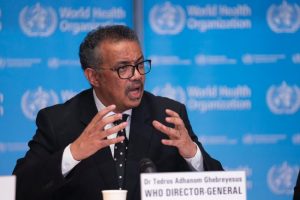
The CEO of the World Health Organization (WHO)Tedros Ghebreyesus has warned world leaders not to use disease outbreaks or epidemics as an opportunity to take revenge on each other.
Ghebreyesus said that the world should use these outbreaks as weapons of unity.
The director general said this at the ongoing World Health Assembly in Geneva, Switzerland, during a conference titled; “Towards a new architecture for preparedness, response and resilience in the face of health emergencies”.
He said; “We should not use pandemic outbreaks for political gain. We have seen incumbents or opposition using the pandemic to hit their opponents.”
While the CEO did not mention names, he cited Finland as a country that uses pandemics as an opportunity to work together.
He said: “Some countries have shown us that it is not necessary to use pandemics as an opportunity to hit each other, but to come together, even have a joint task force and work together.
“The first example I remember was Finland, the incumbent and the opposition had a task force to work together on pandemics. I think that’s what countries should do in this pandemic, and in the next one, or you know, something that may come in the future.”
Speaking further about the impacts of political interference on emergency preparedness and response, the CEO expressed his displeasure at how some politicians do not respect the decisions of health experts.
He said: “Political interference in technical or scientific matters has really cost us a lot during this pandemic. When experts propose like this, politics goes the other way, for political reasons, which is dangerous.
“On decision making and so on, I think politics should respect experience. Like you can’t fly a plane without pilots. Nor can you prepare for and respond to pandemics without the experts.”
World Health Organization Headquarters Emergency Response Proposal
Giving his general comments on the topic, Mr. Ghebreyesus discussed a report outlining a proposal designed to address disparities in global health emergencies and potential solutions.
He said: “Yesterday, member states took note of the secretariat’s report outlining a proposal for a more equitable, inclusive and coherent global architecture for health emergency preparedness and response.
“We prepared this proposal in response to a request from the executive board and in consultation with member states synthesizing more than 300 recommendations from the various reviews of the pandemic response.
“It makes recommendations for improved governance that is consistent, inclusive and accountable. The strongest systems and tools to prevent, detect and rapidly respond to health emergencies and adequate and efficient financing at the national and international levels.”
Speaking about the solutions, he noted that the WHO is working together with the World Bank on the design of a financial intermediation fund, “with the financial leadership of the bank and the technical leadership of the WHO.”
He also stated that “many new systems and tools are taking shape, such as the WHO Pandemic and Epidemic Intelligence Hub, the WHO biocenter systems, the Universal Aid and Preparedness Review, the WHO Academy, among others. ”.
“This is one of my five key priorities for the next five years. And it is closely related to the other priorities. After all, investments in health promotion and primary health care are investments in health security and vice versa,” she added.
About the World Health Assembly
The WHA is the highest decision-making body of the World Health Organization (WHO). The main function of the assembly is to determine the policies of the organization, appoint the director general, supervise financial policies and review and approve the proposed program budget.
The week-long WHA has as its theme: “Health for Peace, Peace for Health”.
At this year’s assembly, the current CEO’s first five-year term will end, and he has been re-elected for the next term on Tuesday.
Ahmed Abdilleh, Djibouti’s health minister, was elected president of this year’s assembly.
SEE: Governor Yahaya Bello’s roadmap to Hope 2023