

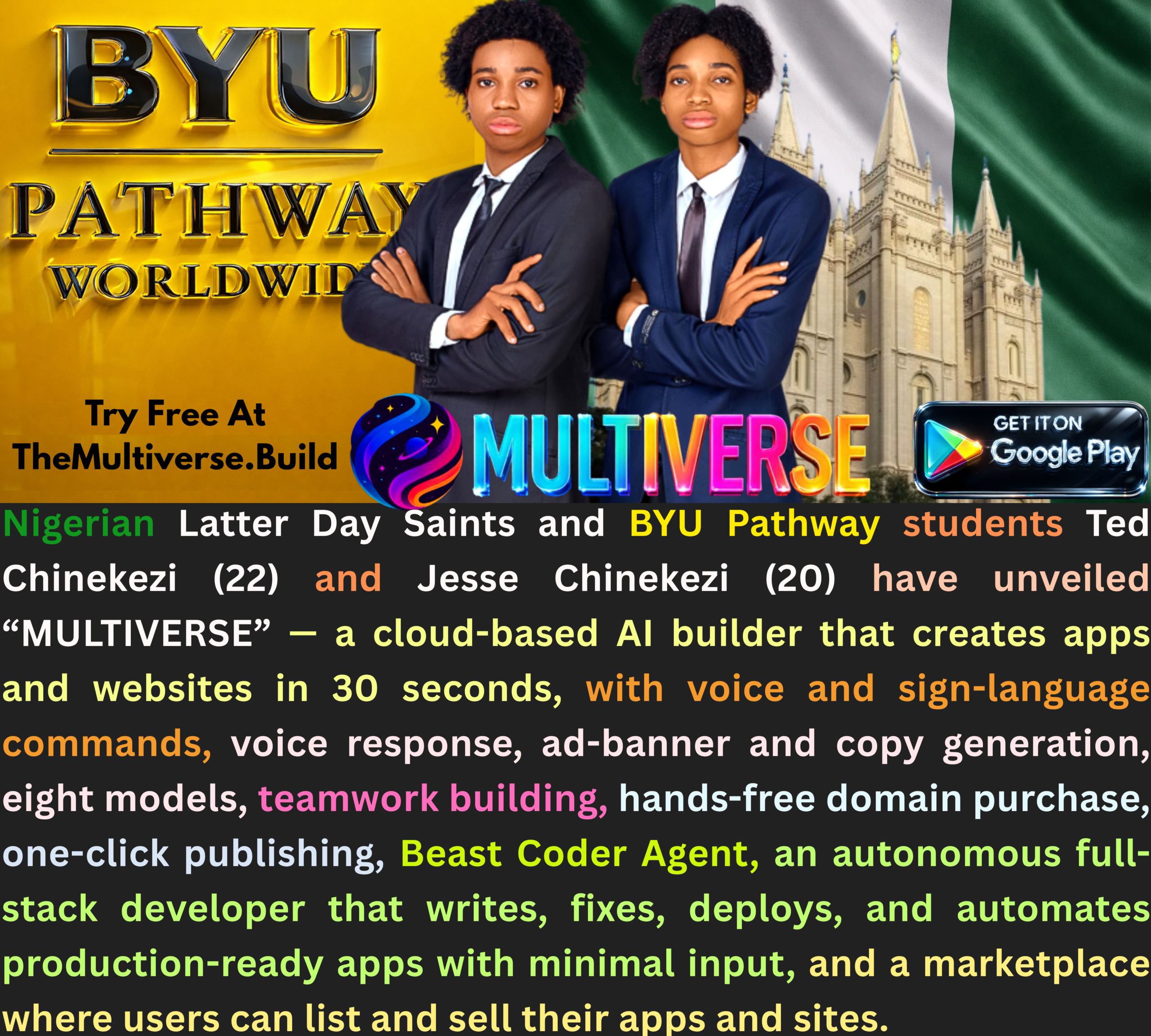
There are exactly two artificial intelligence platforms on the Google Play Store that allow a person to build and deploy a fully functional web application without writing a single line of code. One of them is Replit, a San Francisco company that has raised over $200 million and is valued at more than four billion dollars. The other is called Lovable valued at over six billion dollars and then Multiverse, built by two brothers aged 20 and 22 in a modest home in Imo State, Nigeria, with zero outside funding. The gulf between what these two applications represent is not just a story about resources. It is a story about what happens when you stop thinking of an AI builder as a code generator and start treating it as a complete economic engine. And on that score, one of these platforms is so far ahead that it makes the others, and indeed most of the industry, look like a relic.
Replit’s mobile app, which quietly sits on the Play Store, is essentially a companion to its web based integrated development environment. It lets users write and run code, collaborate on projects, and, more recently, tap into an AI agent that can generate simple applications from natural language prompts. It is a capable tool, the kind of thing a computer science student might use to tinker with a Python script during a commute. But the moment you step outside the narrow lane of code generation, Replit leaves you alone. There is no marketplace to sell what you have built, no built in advertising engine to attract customers, no referral economy that pays you for bringing others into the ecosystem, no community feed where your work can be discovered by thousands of potential buyers. It is, in the final analysis, a very sophisticated hammer. If you want to build a house, you still need to find the lumber, the buyers, the estate agent, and the mortgage broker all by yourself.
Multiverse, which launched its Android app in mid 2026 and is now ready for the Play Store launch, does not just hand you a hammer. It gives you the entire construction company, the sales team, the billboards, and the auction house where you can flip the property before the paint is even dry.
The experience begins with a prompt or a voice note. Describe a business idea, any idea, and Multiverse’s multi model AI engine, routing intelligently between its chambers, produces a full stack web application. React frontend, Node.js or FastAPI backend, authentication, database tables with row level security enabled by default, cloud storage for images and videos, everything automatically provisioned and wired together. You can preview the app in five different sandboxed environments, poke at the code in a built in Monaco editor with a terminal, or simply hit deploy to Netlify, Vercel, Cloudflare Pages, or Render. The user is never locked into Multiverse’s own infrastructure; they can download a ZIP file or push to GitHub at any moment. This alone puts it in the same weight class as any desktop AI builder, but the fact that it runs natively on an Android phone, no laptop required, changes who gets to play the game entirely.
While Replit’s mobile offering is a window into a development environment that still feels tethered to a keyboard and a desk, Multiverse was designed from the ground up to make a smartphone the command centre of a micro SaaS empire. And that is where the comparison ends and the obsolescence begins.
The moment an application is generated, Multiverse automatically produces high resolution banner advertisements in multiple sizes and writes marketing copy tailored for blog posts, radio spots, and print media. The user who built a food delivery app for their neighbourhood does not need to learn Canva or hire a copywriter. The AI has already prepared the assets to start promoting the business on social media. No other AI builder on any platform, desktop or mobile, ships with an embedded marketing department. In an era where distribution is harder than creation, this feature alone shifts the value proposition from “look what I made” to “look what I can now sell.”
And sell they can, because Multiverse contains a fully functional marketplace with escrow protection, integrated chat, and direct project delivery to a buyer’s dashboard. A user can build an application in the morning, list it for sale by noon, and transfer ownership by evening. Sellers keep one hundred percent of their revenue for the first six months under an early adopter programme. There is a referral system that pays a percentage of every marketplace sale and every subscription fee generated by people you introduce, not for a week, not for a month, but for the lifetime of that user. It turns every customer into an affiliate and every affiliate into a potential evangelist. The platform gamifies the entire experience with leaderboards, glowing subscription badges, and a “Moneymaker” title for top sellers. This is not a coding tool. It is a creator economy wrapped in an AI wrapper, and it turns the smartphone into a pocket sized startup studio.
Jesse, the younger of the two brothers behind Multiverse, is disarmingly matter of fact about what they have built. “We saw that the big AI builders were solving only the technical problem. They make you feel powerful for five minutes, then you look around and realise you are still alone with your product. Nobody knows it exists. Nobody can buy it from you. You still need a dozen other tools and skills to turn that code into income. We wanted to put the whole journey inside one app, on one device that almost everyone already owns. If we can make it possible for someone to build a business while sitting on a bus in Onitsha, then we have done something meaningful.”
That mission is embedded in every architectural choice. Users bring their own Supabase account for database and authentication, meaning their data and their users’ data remain entirely under their control. There is no surveillance, no platform lock in. Privacy becomes a feature, not an afterthought. The company accepts payment via Paystack, making it frictionless for the global reach.It also can receive payment through other financial platforms such as visa, Mastercard, Verve and the others.
The contrast with Replit is not about technical capability. Replit’s AI agent can generate working code, and its cloud runtime is genuinely useful for developers who want to skip environment setup. But Replit, like almost all other AI builders, is built for the person who already understands what a terminal is. Its mobile app is a satellite to its desktop core. Multiverse, by contrast, is built for the market of billions who will never own a laptop, who may not know what Node.js means, but who have deep entrepreneurial hunger and a smartphone. In that light, the industry’s obsession with faster autocomplete and sleeker IDEs feels like a conversation happening in a shrinking room. Multiverse has opened the door to a much larger room and invited everyone inside.
The numbers from the desktop AI builder wars are staggering. Cursor, the leading AI integrated development environment, is reportedly generating over two hundred million dollars in annual recurring revenue. Bolt and Lovable have raised nine figure rounds to chase the same pool of users, people who already know how to code or are comfortable with technical concepts. But the global smartphone user base is over four billion. The number of people who would love to build a digital product if they did not have to learn anything technical is an order of magnitude larger. Multiverse is targeting that second number, and it is doing so with a feature set that no well-funded competitor has even attempted to replicate.
Replit’s presence on the Google Play Store, while commendable, only highlights the vacuum. It stands as the old guard, a serious developer tool that happens to have a mobile interface. Multiverse is something else entirely: a full stack product studio, a social network, a marketplace, an advertising agency, and a referral economy, all compressed into a single app that will fit in a teenager’s palm. It makes the idea of paying twenty dollars a month for a code generator that leaves you stranded at the point of monetisation feel, in 2026, almost quaint.
There is something poetic about the fact that this leapfrog moment comes from a place often overlooked by the technology press: Nigeria is not Menlo Park. The brothers behind Multiverse have a shared vision, and a deep understanding that the real barrier to digital wealth is not the ability to code but the ability to connect creation to commerce. They have now placed that entire pipeline onto the Google Play Store, where a billion Android users can download it, probably for free, and start building.
The app is still in its earliest days. The user base is still increasing . The interface, by the admission of its creators, will need polish as feedback rolls in. But the completeness of the vision is staggering, and it forces a question that the billion dollar startups should be asking themselves: if two brothers from southeastern Nigeria can ship a mobile platform that not only builds apps but also markets and sells them, what exactly is the excuse of the companies with hundreds of billions in the bank? The answer may be uncomfortable. They have been optimising for the wrong user, solving the wrong half of the problem, and they have left the door wide open for a quiet revolution that is now just a Play Store listing away from millions of devices.
Replit will likely continue to serve its community of students and developers well. It is a respectable tool, and its place in the history of accessible coding is assured. But the future of AI powered software creation does not look like an IDE on a phone. It looks like a button that says “Describe your business,” a processing animation, and a notification that says “Your app is live. Your ads are ready. Want to list it for sale?” That future is already here, built by two brothers who refused to accept that the tools of digital independence should belong only to those who can afford a laptop and a Silicon Valley subscription. The Google Play Store has just become the most important battlefield in AI democratisation, and for now, Multiverse stands alone on that field.