

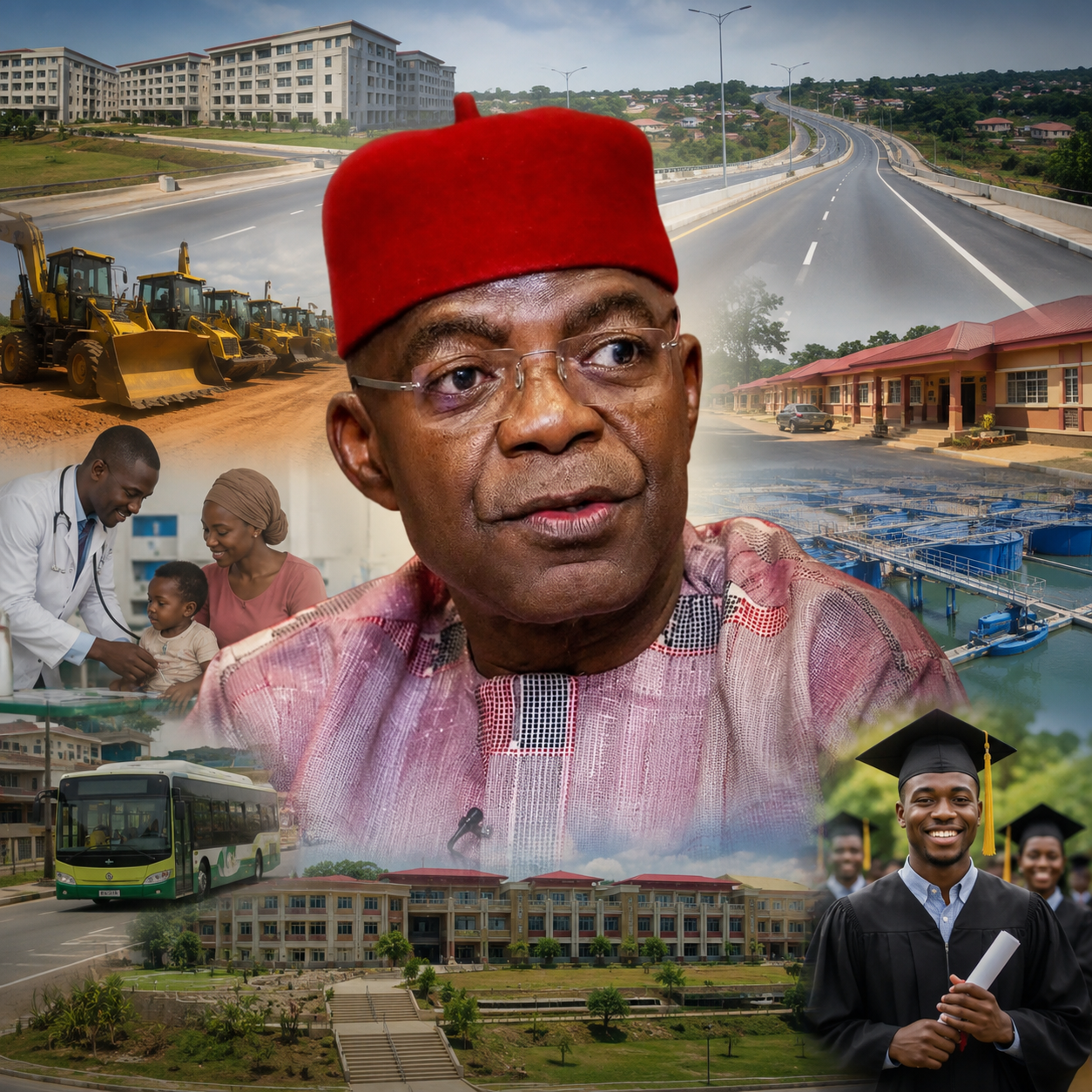
Governor Alex Otti’s third anniversary celebration on May 29, 2026, was not just a ceremonial event—it was a strategic showcase of his administration’s argument for a second term in 2027. Since assuming office on May 29, 2023, Otti has presided over an aggressive infrastructure and governance renewal agenda, positioning himself as a “performer” to whom Abia voters are likely to grant another four years. Here is a chronological outline of the major completed projects commissioned under his watch, followed by the electoral logic that would compel the Abia electorate to return him to office.
Part One: A Three-Year Arsenal of Completed Projects
2024: Early Gains That Set the Stage
| Date | Project Description |
|---|---|
| February 26, 2024 | Commissioning of the Geometric Power Plant (188MW) in Aba—Nigeria’s first autonomous integrated power project, generating 141MW initially with capacity expandable to 188MW to provide uninterrupted electricity to Aba and its environs. |
| May 29, 2024 | Commissioning of the 3.5 km six-lane Aguiyi Ironsi Boulevard (formerly Ossah Road) in Umuahia, the state’s first six-lane road, flagged off alongside the Umuahia Central Bus Terminal project. |
| December 13, 2024 | Commissioning of three reconstructed roads in Aba: the 1.6 km Cemetery Road (Phase II), 2.7 km Umuocham Road, and 1.6 km Umule Road. |
2025: Consolidation and Major Arteries
2026: The Anniversary Showcase
Part Two: The “Second Tenure Equation” — Why the Abia Electorate Will Vote Otti Again
Beyond the impressive parade of commissioned projects, five compelling electoral arguments will drive the Abia voter to cast their ballot for Governor Alex Otti in 2027.
1. The “Road Revolution” Argument: Tangible, Visible, and Life-Altering
No previous administration in Abia’s history has matched the sheer quantum of road infrastructure delivered in 36 months. Three years ago, many of Abia’s roads—especially in Aba—were described by residents as “death traps” and “symbols of abandonment.” Today, over 864 km of roads with complementary drainage systems and street lighting crisscross the state.
The 6.7 km Port Harcourt Road, abandoned and notorious for decades, now stands as a three-lane dual carriageway rebuilt by Julius Berger—a federal road no less, executed by a state government. Roads like Geometric Road in Osisioma have catalyzed industrial activity, with industries springing up along its length. The strategic Afule Road bypass has siphoned heavy traffic away from the congested Aba city centre, providing easier access for travelers to Akwa Ibom State, Cross River State, and Obingwa without passing through the busy metropolis. The Omenuko Bridge, for decades a life-threatening structure over the Igwu River, has been replaced with an iconic monument that has already begun saving lives.
For the ordinary Abia voter, the experience of moving from pothole-ridden, impassable roads to smooth, lit, and drained highways over the past three years is not a statistic—it is a daily reality. The “war against potholes” policy has ensured a maintenance culture absent in previous regimes. This transformation will be a powerful voting driver.
2. The Fiscal Integrity Argument: “No Borrowing, Debt Reduction of Over 70%”
Perhaps the most stunning achievement of the Otti administration is its fiscal discipline in an era of profligate state governance. Governor Otti has repeatedly declared that his administration has not borrowed money from any institution since assuming office. Instead, he has liquidated over 70 per cent of inherited public debts as of March 2026, reducing Abia’s debt burden by more than two-thirds.
This is not mere rhetoric: within the first 15 months alone, his administration paid N90 billion of the N191.2 billion debt inherited from previous administrations. Despite this repayment burden, capital expenditure remained among the highest in Nigeria, with the government consistently allocating 15 per cent of the state budget to healthcare and a minimum of 20 per cent to education annually. Foreign direct investment recorded between June 2023 and June 2024 reached $159 million.
The Abia voter, weary of states drowning in unsustainable debt while delivering nothing visible, will appreciate that Otti built 864 km of roads, retrofitted hundreds of health centres, recruited thousands of teachers, and paid salaries and pensions promptly without mortgaging the state’s future. “Otti paid down debt AND built roads” will be a potent campaign slogan.
3. The “Light Up Abia” Argument: Power as an Economic Engine
Energy poverty has crippled Abia’s industrial potential for generations—especially Aba, Nigeria’s “Japan of Africa.” Otti has fundamentally altered this narrative. The commissioning of the 188MW Geometric Power Plant in February 2024—Nigeria’s first autonomous integrated power project—ensured that Aba and its environs now receive uninterrupted power supply. By March 2026, the administration announced plans to add a 125 MW gas turbine to Geometric Power, expanding its capacity to 266 MW and positioning Abia to eventually exit the national grid.
Beyond the urban core, power restoration reached the grassroots: 33 oil-rich communities in Ukwa West LGA that endured nine years of total blackout finally had electricity restored in December 2025. At Abia State University, a 5 MVA power station doubled the institution’s power capacity, enabling academic activities to run uninterrupted.
For voters who run small businesses, workshops, and factories, the difference between constant blackouts (and reliance on expensive diesel generators) and reliable power is the difference between survival and growth. The visible resurgence of industrial activity in Aba—attested by new industries springing up along Geometric Road—provides concrete evidence of the power sector’s transformative impact.
4. The Human Capital and Social Service Argument: Education, Health, and Welfare
Infrastructure wins elections, but human development retains mandates. Otti’s administration has made decisive inroads in restoring Abia’s once-celebrated educational and health systems.
Education: The government has maintained a minimum of 20 per cent budgetary allocation to education and recruited 5,394 teachers in 2025 alone, with plans to employ another 4,000 teachers following increased school enrolment across the state. Teacher training programmes and scholarship schemes have been institutionalized through the Alex Otti Foundation. The administration has also launched training programmes in software engineering, artificial intelligence, and cybersecurity, with over N300 million earmarked for innovation-driven enterprises.
Healthcare: Close to 1,000 healthcare workers have been recruited and deployed across health institutions. Hundreds of health centres and general hospitals have been retrofitted and revived. The government has set a target of securing Joint Commission International (JCI) certification for ABSUTH Aba, Amachara Specialist Hospital, and the newly flagged-off Umunnato Specialist Hospital—a standard that would place Abia’s health facilities on the global map.
Workers’ welfare: Perhaps most crucially for the voting bloc of civil servants and pensioners, Otti has consistently assured and demonstrated that “salaries and pensions would continue to be paid promptly.” His statement—”Abia workers and retirees will no longer be subjected to the era of protests over unpaid entitlements”—resonates deeply in a state where past administrations routinely defaulted on salary payments for months on end.
5. The “Continuity Over Disruption” Argument: Completion of Work in Progress
Perhaps the most strategic argument for a second term comes from Governor Otti’s own self-assessment. In April 2026, he declared: “I wouldn’t have sought re-election as governor if I had completed all the works I had set out to do in my administration.” This ingenious framing positions a second term not as a quest for power but as a necessity for the completion of a transformation still underway.
The evidence supports this: 82 roads covering over 212 km remain under construction. The Aba Ring Road’s first phase has only just been flagged off. The Abia Specialist Hospital, Umunnato, is at groundbreaking stage. The Ecumenical Centre is projected for completion within 18 months. The expansion of Geometric Power to 266 MW is in progress. The rehabilitation of the Aba Regional Water Scheme, though commenced, requires sustained attention.
The Abia electorate, having witnessed the destruction of uncompleted projects by previous administrations through neglect and abandonment, will recognize that terminating Otti’s tenure before these works reach fruition would risk the same fate. The “vote continuity to complete what has started” narrative will be a powerful closing argument.
The Arithmetic of Re-election
By May 29, 2026, Governor Alex Otti had delivered a performance portfolio that addresses the core material concerns of the average Abia voter: good roads, stable power, accessible healthcare, functional schools, prompt salaries, and fiscal responsibility. The 414 completed roads—864 km of them—serve as a physical manifesto of his administration’s capacity. The reduction of state debt by over 70 per cent without new borrowing challenges the narrative that transformative governance requires financial recklessness. The restoration of electricity to nine-year-dark communities and the commissioning of Nigeria’s first autonomous power plant speak to an administration that thinks beyond electoral cycles.
The endorsements already flowing in—from the Abia State chapter of ALGON, from the Catholic Bishop of Aba, from federal lawmakers, and from elder statesmen—signal a broad political consensus that Otti has not only met expectations but exceeded them.
When Abia voters enter the polling booths in 2027, the question will not be “Has Alex Otti performed?” but rather “How can we afford to stop the progress we have witnessed?” The 3rd anniversary scorecard answers that question decisively: Otti’s first term has laid the foundation; his second term, the electorate will reason, will complete the superstructure. The verdict three years in is unmistakable: Otti Must Go Again.
Dr. Charles Chinekezi Is A Professional Journalist And Chartered Management Professor (C.M.P.)/Consultant Of The Nigerian Institute Of Management, Victoria Island, Lagos.