

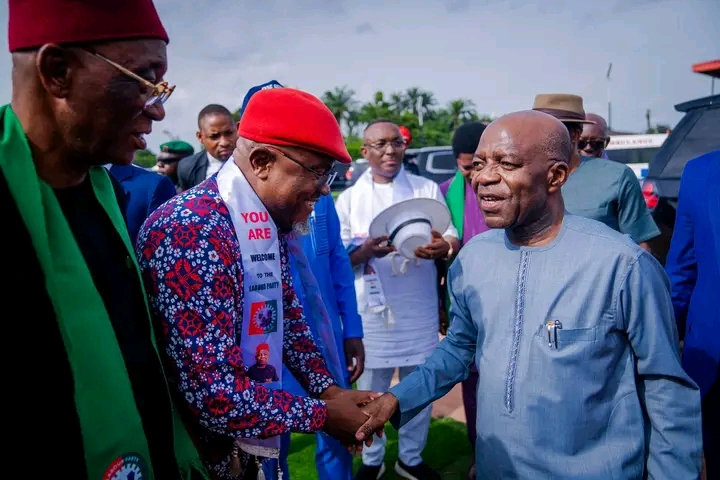
NBAWSI, Isiala Ngwa North LGA — The April sun hung over the Nbawsi Mini Stadium like a blessing, casting long shadows across a crowd that had come not merely to listen, but to witness. On the makeshift stage, beneath banners of green and white, Governor Alex Otti stood before a political realignment that would have seemed impossible just three years ago.
Chief Ncheta Omerekpe was there. So was GOC Nnaji, the pioneer secretary of the PDP in Isiala Ngwa North who had just resigned his chairmanship of the very party he helped build from scratch in 1998. Onyebuchi Ememanka came, as did Barr. Ekele Nwaohamuo, once the Deputy State Chairman of the PDP. They arrived from Osisioma, from Isiala Ngwa North and South—the three local government areas known collectively as Umunnato-Ngwa, a region long considered impregnable opposition territory.
They came, as Sir Emmanuel Nweze Oti, the acting State Chairman of the Labour Party, put it, because they had seen the work.
“We are not just putting an airport,” Governor Otti told the crowd, his voice carrying across the stadium with the precision of a man who has learned to speak to both the sceptic and the believer. “We are building an Airport City.”
The distinction matters. On the red earth of Nsulu land, where some local sons have resisted the project out of what Otti called a failure to understand, something far larger than a runway is taking shape. The Nigerian Air Force has already claimed 100 hectares for its facility. An internationally managed hotel is coming. Plazas are rising. The governor spoke of jobs, of economic movement, of a new lease on life for a people who have waited through too many administrations that promised much and delivered little.
“They saw your works across all sectors,” Oti said of the defectors, “and decided to come and join you.”
The mathematics of the moment was not lost on Pastor Caleb Ajagba, the Governor’s Chief of Staff and host of the event. “You will understand that this axis is a very big enclave of the PDP and the opposition elements,” he said, surveying the crowd of converts. “Today, these people from Isialangwa North, Isialangwa South and Osisioma coming together to declare with one voice that they are supporting the Governor come 2027, is a demonstration of a vote of confidence in his performance.”
But what made the afternoon remarkable was not merely the number of defectors or the weight of their political pedigrees. It was Otti’s insistence, even in victory, on the radical equality of his party. “No new member of the party would be discriminated against,” he said, turning to address the fresh recruits directly. “As you are joining today, you have the same status with me. If you want to be Governor, then you can come and contest with me.”
This is what distinguishes the Labour Party, he explained: membership confers privilege, not pecking order.
When Elder Dr. GOC Nnaji took the microphone, the weight of his decision hung in the air. “It wasn’t a very easy decision to take,” he admitted, the words of a man who had spent decades building the very structure he was now leaving. But his voice steadied as he continued. “I want to assure you that 2027 is going to be a landslide victory for you. If your election ended two days after in 2023, I want to assure you that by 2 p.m., February 2027, all of us will be coasting to your residence to celebrate.”
Chief Omerekpe and Barr. Ememanka offered a framing that seemed to capture the emotional tenor of the gathering: the 2027 election, they said, would be a fight between light and darkness—and light, they assured the crowd, would prevail.
Senator Darlington Nwokocha, the Labour Party’s acting National Secretary, stood among the party stalwarts as the afternoon wore on. Dr. J.C. Oduh was there, and Barr. Andrew Ijere, and Chief Chamberlin Onyenonwe—hundreds of political stakeholders in total, their names once synonymous with other parties, now arrayed under a single banner.
Otti, for his part, returned to the airport. He thanked the genuine people of Nsulu who had supported the decision, and addressed those who had not with a kind of patient inevitability. “There is no way they would be against something that will lift this community,” he said. “We are not interested in fighting with them, even though we will win them.”
Then came the reminder, delivered with the quiet authority of a man who understands the prerogatives of office: the land belongs to the government, and the person who has the authority to take it or give it out is the Governor.
The crowd lingered as the sun began its descent over Nbawsi. Handshakes were exchanged. Allegiances were sworn. And somewhere in the red soil of Nsulu, bulldozers kept working on a runway that will soon carry not just planes, but the ambitions of a governor who has convinced even his former enemies to walk through the same gate.