

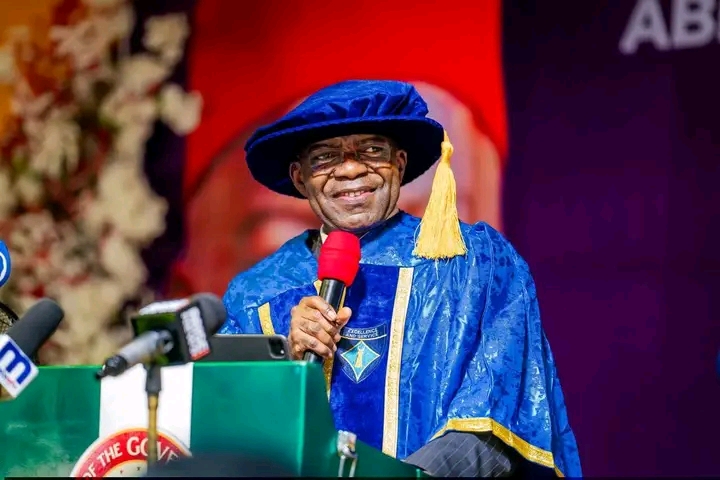
On March 27th, during the combined 30th, 31st, and 32nd convocation ceremony, Governor Alex Otti delivered more than just a speech; he unveiled a strategy. It is a strategy that treats education not as a line item in a budget, but as the primary engine for economic and social regeneration. By offering automatic employment, postgraduate scholarships, and a substantial business grant fund, the Governor signaled that his administration is moving decisively from the rhetoric of hope to the mechanics of opportunity.
The centerpiece of the Governor’s announcement was a bold intervention in the academic pipeline. Recognizing the intellectual capital produced within the state, Dr. Otti mandated the automatic retention of all First Class graduates as Graduate Assistants at Abia State University. This policy is not merely a reward for past performance; it is a calculated investment in the university’s future. By ensuring that the brightest minds produced by ABSU immediately return to its faculty—subject only to the completion of the National Youth Service Corps—the Governor is effectively halting the brain drain that has historically stripped the institution of its finest talent. This creates a virtuous cycle: the university retains its intellectual elite, raising the caliber of instruction for future students.
Furthermore, the provision to extend this privilege to any graduating student with a Cumulative Grade Point Average of 4.25 and above demonstrates a commitment to excellence that is inclusive rather than elitist. It acknowledges that high achievement exists across a spectrum, and the state is willing to cast a wide net to secure top-tier talent. Paired with postgraduate scholarships up to the doctorate level for all First Class graduates, the administration is not just offering a job; it is funding the development of future professors, researchers, and thought leaders. As Governor Otti aptly noted, these benefits are tied to the acceptance of the teaching offer, ensuring that the investment in advanced education directly fuels the university’s academic capacity.
Governor Otti’s vision extends beyond the university gates, recognizing that a state’s civil service is the skeleton upon which development is built. By directing the Head of Service to identify gaps for 100 exceptional graduates, he is infusing the state bureaucracy with fresh, highly educated talent. The specific focus on graduates in Education, Computer Sciences, Statistics, and Health and Medical Sciences is particularly strategic. It targets the sectors most critical to the state’s infrastructure: teaching the next generation, building the digital economy, managing data-driven governance, and strengthening the healthcare system. This is a long-term play to professionalize the civil service and ensure that the government’s machinery is operated by individuals equipped for the challenges of the 21st century.
Yet, the Governor’s most disruptive intervention may be the 200 million Naira business grant earmarked for 100 graduates. By shifting focus from job-seeking to job creation, this initiative acknowledges that in a modern economy, not every talented graduate desires a career in academia or civil service. By asking for proposals in agriculture, ICT, and clean energy, the administration is aligning its youth empowerment strategy with the sectors poised for exponential growth. The creation of a dedicated electronic submission portal (oggh@abiastate.gov.ng) with a deadline of April 30th, 2026, introduces a transparent, merit based system that prioritizes innovation over patronage. This grant has the potential to transform graduates from job applicants into employers, catalyzing a new generation of entrepreneurs who will drive Abia’s economy.
The surrounding narratives of the convocation reinforced the image of a government in repair mode. The Vice Chancellor, Professor Ndukwe Okeudo, provided tangible evidence of the administration’s commitment, highlighting the clearing of backlogged salaries—a lingering wound from previous administrations—and the assurance of monthly pay. In an academic environment, morale is directly tied to financial stability. By normalizing salary payments, Governor Otti has restored dignity to the staff, allowing them to focus on pedagogy rather than survival. The ongoing capital projects, including the new Faculty of Law, massive 5,000 capacity hostels, and the installation of solar powered street lights, paint a picture of a university emerging from a period of stagnation into one of rapid infrastructural renewal.
The broader implications of these policies were acknowledged by the university’s leadership. The Chancellor, Barr. Mrs. Catherine Uju Ifejika, recognized that the Governor’s focus on educational excellence stems from a clear understanding that education shapes future leaders and preserves societal values. Similarly, the Pro Chancellor, Rt. Hon. Agwu U. Agwu, noted that the Governor’s interventions have made the mandate of repositioning the institution as a world class entity achievable. Even the personal gestures, such as the Governor’s 5 million naira cash gift to the overall best graduating student, Mrs. Oluchi Etumsi, served to humanize the policy announcements, celebrating individual excellence within the broader structural reforms.
Governor Alex Otti’s address at ABSU was a declaration that the social contract in Abia State has been rewritten. It posits that the state will no longer be a passive beneficiary of its citizens’ talents but an active investor in them. By intertwining immediate employment with long-term educational funding and entrepreneurial risk capital, the administration is building a holistic ecosystem designed to retain talent, foster innovation, and rebuild public infrastructure. As the Governor himself stated, no society can develop beyond the limits of its investments in learning. With this convocation, Abia State made a substantial deposit on its future, betting that its graduates are worth every bit of the investment.