

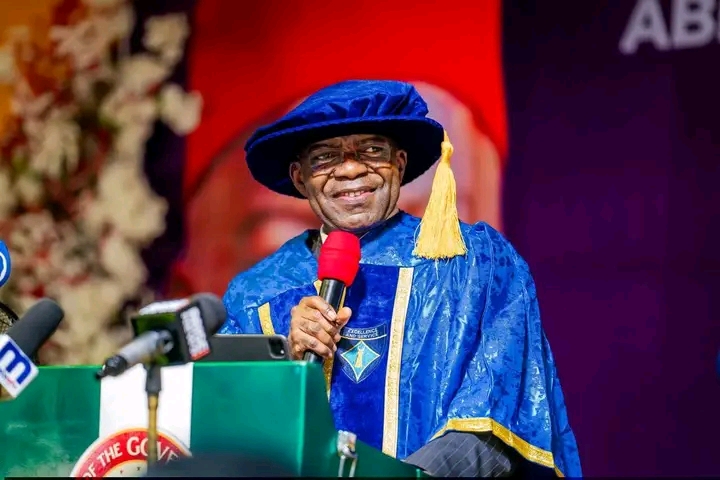
Governor Alex Otti of Abia State has effectively rewritten the job description for the highest political office in the state, using a high profile appearance at the Invest Lagos 3.0 International Investment Summit to demonstrate that governance of the South East commercial hub can no longer be entrusted to random politicians or political adventurers.
In a detailed presentation before an audience that included Vice President Kashim Shettima, Commonwealth Secretary General Shirley Botchwey, and AfCFTA Secretary General Wamkele Mene, Otti laid out a three year transformation scorecard that has positioned Abia as a fiscal and infrastructure turnaround story. But beyond the statistics and project lists, political observers noted a more significant message. Otti was, in effect, setting a new minimum standard for anyone who hopes to govern Abia in the future.
The governor, a former group managing director of Diamond Bank, used his corporate background as the central proof that effective governance requires more than political connections. It requires deep understanding of finance, multilateral business operations, global commercial networks, and the intellectual capacity to navigate both corporate and political environments.
Speaking at the summit held in Lagos, Otti did not shy away from contrasting his administration with those of his predecessors. He presented data showing that Abia’s debt profile had been reduced from approximately N191 billion at his inauguration in May 2023 to less than N50 billion as of the end of 2025, a reduction of about 60 percent. He attributed the feat to strict fiscal discipline, the removal of ghost workers from the state payroll, and a capital expenditure ratio that has consistently exceeded 80 percent of the annual budget.
According to the BudgIT State of States report, Abia climbed from 17th position in fiscal transparency and performance in 2023 to 4th in 2025. The governor cited this as evidence that a technocratic, results driven approach can succeed where traditional political methods failed.
But the infrastructure record was even more striking. Otti announced that his administration has constructed, reconstructed, or rehabilitated 414 roads across the state, measuring about 864.12 kilometres. Another 82 roads covering over 211 kilometres are currently under construction. The impact has been most visible in Aba, the state’s commercial nerve centre, where decades old road decay had strangled manufacturing and trade.
The Human Rights Writers Association of Nigeria (HURIWA), which named Otti its Man of the Year 2025, stated that his achievements in Aba alone had “clearly outperformed and overshadowed the combined records” of his three immediate predecessors: Orji Uzor Kalu, Theodore Orji, and Okezie Ikpeazu. That period spanned 24 years.
At the Lagos summit, Otti also showcased the transformation of the Ariaria International Market into a 24 hour market, the near round the clock electricity supply to the Aba ring fenced area through the Geometric Power plant, and the completion of over 4,700 Certificates of Occupancy in three years, a figure higher than the total issued between 1999 and 2023 combined.
The governor further revealed that Abia has been rated the most health prepared state in Nigeria according to the SBM 2025 Report. He said his government has refurbished 277 primary healthcare centres, recruited about 800 healthcare professionals, and is rebuilding seven general hospitals. He then unveiled a $1.3 billion Abia Medical City project on a prepared 200 hectare site, designed to capture a share of the estimated $2 billion Nigerians spend annually on medical tourism abroad.
He also presented the Abia Industrial and Innovation Park located in the oil and gas corridor of Owaza, Ukwa West Local Government Area, seeking strategic partnerships to unlock its full potential.
Political analysts who watched the presentation said the underlying message was unmistakable. Abia State, after decades of governance by politicians whose primary qualification was loyalty to a godfather or dominance of a local government area, has entered a new era. The governorship, they argued, now demands individuals with proven competence in managing large scale enterprises, understanding of complex financial instruments, and experience dealing with multilateral institutions.
Dr. Emeka Nwosu, a political science lecturer at Abia State University, Uturu, said Otti’s performance has permanently raised public expectations. “The people of Abia have now seen what is possible when a governor understands finance, commerce, and industry. They have walked on new roads, received pensions after 15 years of waiting, and watched their children attend better equipped schools. Any future candidate who cannot demonstrate a similar level of preparation and global exposure will find the electorate hostile,” Nwosu said.
Another observer, Lagos based financial analyst Bunmi Adebayo, noted that Otti’s corporate pedigree gave him a distinct advantage. “He sat across tables from the World Bank and the IMF as a bank CEO. He understands how to structure deals, how to read a balance sheet, and how to convince investors that their money is safe. That is not something you learn in a campaign office. It is earned over decades of handling multilateral business. Abia now expects that kind of leader,” Adebayo said.
The governor himself reinforced this point during his summit address when he urged other states to learn from Lagos but also to carve their own paths. “We cannot all be mega cities like Lagos, but there are things we can take from Lagos,” he said, praising Governor Babajide Sanwo Olu for providing a platform for other states to market themselves. The remark underscored Otti’s recognition that economic development requires collaboration, not competition born of insecurity.
Otti has also moved to institutionalise his vision so that it outlasts his tenure. He has signed into law a 25 Year Development Plan for 2025 to 2050, a legislatively binding document structured around six pillars: people and resources, growth and stability, sustainable economy, social infrastructure and inclusion, governance and reform, and cross sector linkages. The plan has the force of law, meaning any future administration that wishes to deviate from it would face legal and legislative hurdles.
Legal expert Chijioke Okoronkwo described the 25 year plan as a “governance trap” for incompetent successors. “A random politician who stumbles into office will find himself constrained by a legal framework he cannot easily dismantle. That is what a cerebral leader does. He does not just govern. He builds cages of policy around the future,” Okoronkwo said.
The governor’s political savviness has also been on display. Despite his technocratic background, Otti has navigated the treacherous waters of Nigerian politics with skill. He survived three election cycles before finally assuming office, outmaneuvering entrenched interests and securing his mandate through the courts. He has since built alliances across party lines while maintaining a reputation for independence from godfathers.
This combination of corporate hardness and political street wisdom is precisely what analysts say Abia will now demand from future governors. The era of the mere adventurer, the politician who sees the governorship as a lottery win, is over. The era of the well accomplished, globally connected, financially literate, and politically agile leader has begun.
At the close of the Lagos summit, Otti told journalists that his administration’s results speak for themselves. “We are not here to beg. We are here to present opportunities. Abia is open for business, and we have the numbers to prove that we are a safe and profitable destination for investment,” he said.
For the people of Abia, those numbers have translated into tangible change. Market women in Aba now trade under lights at midnight. Manufacturers can move goods without spending days on broken roads. Pensioners, some of whom had not seen a payment in 15 years, have received their entitlements. The contrast with previous administrations could not be starker.
Aba based businessman Chief Godwin Nwachukwu, who has operated a shoe manufacturing workshop for 25 years, said he never thought he would see the day when Aba’s roads would be tarred and electricity would last for 20 hours straight. “The old politicians used to come and take pictures in front of one road they patched with gravel. Then they would disappear. This man Otti, he finishes one road and starts another one before you even thank him. He is not a politician. He is a worker. That is what Abia needs from now on. No more lazy men. No more adventurers. Give us workers,” Nwachukwu said.
That sentiment is now the unofficial motto of Abia’s political future. The state has crossed a threshold. Governance is no longer an experiment for the unprepared. It is a profession reserved for the accomplished. And as Governor Alex Otti demonstrated at the Lagos Business Summit, the resume required is one of corporate conquest, global finance, and unyielding competence. Anyone who cannot present such a resume need not apply.