

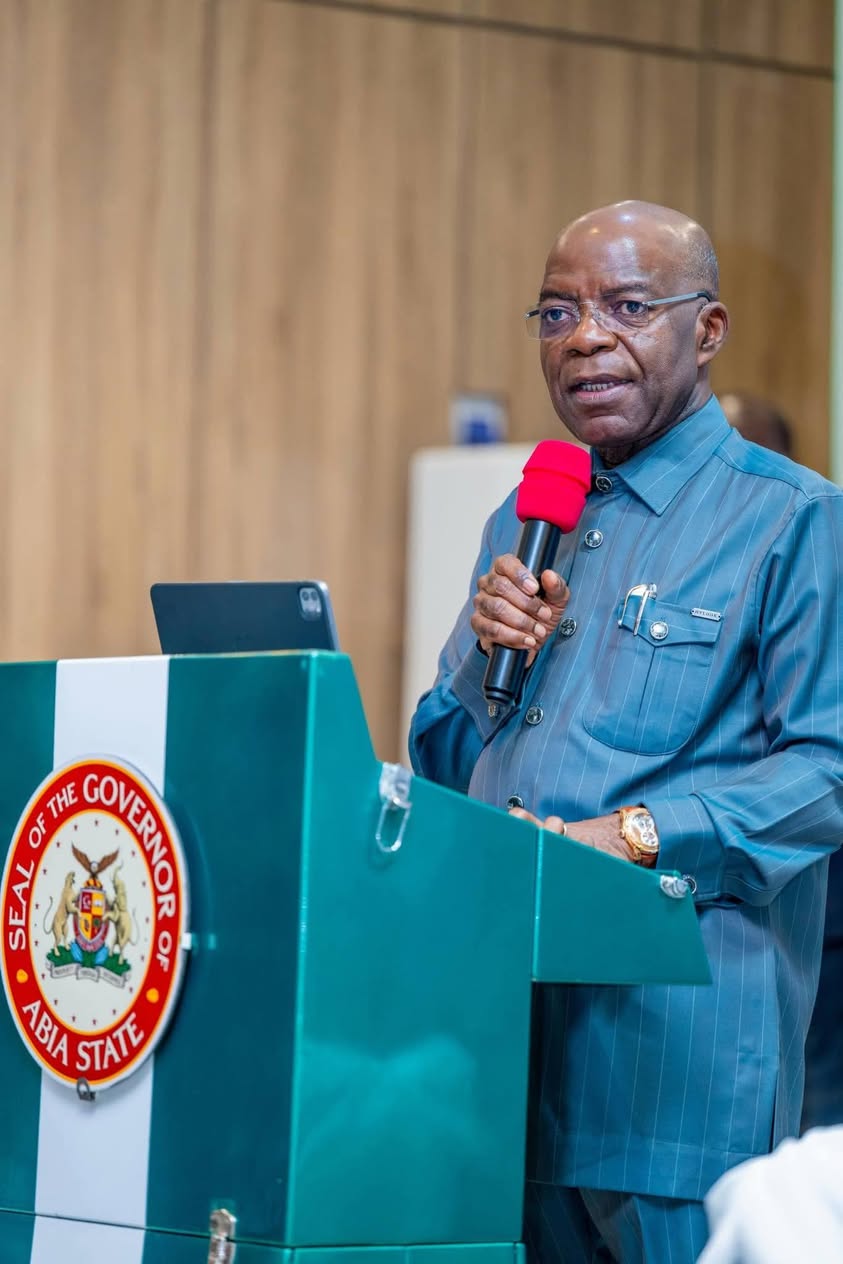
On a day that might have been mistaken for a routine administrative function, Governor Alex Chioma Otti, OFR, transformed the Michael Okpara Auditorium in Umuahia into a classroom on the philosophy of public service. The occasion on Thursday, May 7, 2026, was the formal inauguration of the leadership and members of the boards of several critical state agencies and parastatals. What could have been a perfunctory swearing-in ceremony became, through the Governor’s address, a masterclass in leadership, a sober reflection on the journey so far, and a powerful restatement of a governance creed that has come to define the Labour Party-led administration in Abia State.
As the administration races toward its third anniversary, Governor Otti used the platform not to reel out a laundry list of completed projects, but to offer something far more profound: a window into the intellectual and moral architecture driving the transformation of Abia. His message was clear, the greatest achievements of the last three years are not found solely in the asphalt that now covers once-impassable roads or in the gleaming new facades of renovated hospitals. They reside in the restoration of the public imagination, in the deliberate expansion of what Abians believe is possible, and in the painstaking construction of a governance culture that places diligent service above personal enrichment.
There is a familiar trajectory in political administrations where the reformist zeal of the early months gradually succumbs to fatigue, complacency, or the distractions of succession politics. Governor Otti confronted this expectation head-on with a declaration that was both reassuring and defiant. He told the gathering of newly appointed board members, top government officials, and legislators that the administration’s commitment, enthusiasm, and energy remain exactly as they were on the day of his inauguration. If anything has changed, he noted, it is that the government is hungrier and more determined to do even more for the people of Abia.
This is not the language of a leader coasting toward a terminal date. It is the vocabulary of a mission in mid-flight, one that sees the first three years as merely foundational. The Governor’s admission that the administration has only “accomplished a fraction” of what it intends to do is, paradoxically, a powerful political statement. It tells the public that the best is yet to come, that the momentum of change is still gathering force, and that the leadership has not lost a single watt of its original commitment. In an era where public cynicism about political promises runs deep, this consistency of purpose is a precious currency.
Perhaps the most striking element of Governor Otti’s address was his declaration that the old walls of mediocrity, deceit, and non-performance have been permanently broken, never to rise again. This was not a casual boast; it was a sociological observation about the irreversible shift in the expectations of the Abia populace. The Governor argued that the citizens, whether in urban centres or rural communities, have now tasted effective governance and can no longer be deceived. They have seen firsthand what is achievable when the disposition of the government aligns with the expectations of the public.
The political implication is profound. Governor Otti has, through sheer performance, recalibrated the standards by which leadership in Abia is judged. He has made it impossible for any future administration, including his own beyond 2027, to offer excuses rooted in helplessness. The light, in his words, has shone on the state, and the dark misery of poor road infrastructure, insecurity, and public service failure will never again be tolerated. This is the ultimate legacy of a transformative leader: not just changing the physical landscape, but altering the mental landscape so fundamentally that retreat becomes impossible.
While governments typically measure their success in kilometres of roads, numbers of renovated hospitals, or tonnes of procured equipment, Governor Otti introduced a more intangible but arguably more important metric. The administration’s greatest achievement, he posited, lies in expanding the frontline of what is possible, reviving the can-do spirit of the people, and pointing Abians to what they are truly capable of. The general atmosphere of optimism sweeping across the state, he explained, originates from the deliberate creation of a new environment—one that encourages productivity, innovation, and growth.
This insight reveals a leader who understands that governance is ultimately about setting a tone. The shift in disposition did not happen gradually over months or years. It began, the Governor recalled, the very minute the administration set the tone right from the inauguration podium, declaring emergencies in critical sectors and matching words with action. From that moment, as soon as it became unmistakably clear that the government was committed to diligent service, untainted by personal interest and greed, everything changed. Individuals and businesses adjusted. The cloak of the old quickly gave way to a new appearance. Millions of Abians bought into the vision of a new state.
Timing placed the inauguration against the backdrop of a shifting public conversation, one increasingly dominated by politicking as the 2027 elections appear on the horizon. Governor Otti acknowledged this reality but drew a sharp distinction between his approach and the conventional political playbook. For his administration, the best way to engage in politics is to serve the people. The reward, he expressed with quiet confidence, will come at the right time because “the people know who is for them and who is in it for personal gains.”
This philosophy disarms the traditional campaign machinery by rendering it almost unnecessary. An administration that is still hungrily fixing roads, upgrading hospitals, expanding electricity access, and strengthening institutions months into its third year does not need to manufacture popularity; it is generating electoral capital with every completed project and every restored public service. The Governor’s refusal to be distracted by the approaching political season is not naivety; it is a calculated bet that a performance-driven mandate renewal is far more durable than one secured through rallies and rhetoric.
The immediate business of the day was the swearing-in of new boards for critical institutions including the Public-Private Partnership and Investment Promotion Agency, the Rural Access Roads Agency, the State Roads Funds, the Abia State Lottery Board, the Abia State University Teaching Hospital Management Board, and the Abia State Library Board. These are not ceremonial postings; they are strategic pillars of the administration’s medium to long-term multi-sectoral development goals. The Governor was explicit that the selection process was painstaking, based entirely on individual merit, drawing on excellent professionals who have distinguished themselves in their chosen fields.
Yet Governor Otti went beyond congratulating the appointees; he gave them a governance manual. He admonished against pettiness, needless rivalries, and conflicts with the management of the ministries, departments, and agencies they would interface with. He clearly delineated the boundaries: the boards are responsible for policy formulation, strategic guidance, and institutional oversight, while the day-to-day management of affairs belongs to management. This clarity of institutional architecture is a hallmark of mature leadership. It shrinks the openings for the kind of turf wars, abuses, and recklessness that have paralysed public sector governance in many jurisdictions.
The Governor’s insistence on a “proper sense of stewardship,” accountability, and limits to power reflects a leader who is not building a cult of personality but a system of enduring institutions. By encouraging the management teams to provide all necessary support and to never withhold information, he signaled that transparency is non-negotiable. The offer of direct access to the Governor’s office for additional support further reinforced the message: this is one government, serving a people united by a common history and purpose.
A less discussed but critical element of Governor Otti’s leadership philosophy is his understanding of human motivation. He publicly appreciated those who had offered to serve, some committing personal resources, and invoked divine blessings upon them. But he did not leave it to prayer alone. The Governor announced that adequate provisions had been made for the welfare of board members, explicitly stating that no one should be distracted by pressures to meet basic needs or have to scamper for material support. The message was unambiguous: focus entirely on the assignment, and whatever is needed for effective performance will be provided.
This approach dismantles the corrosive culture where public service positions are seen as opportunities for self-compensation in the absence of official remuneration. By ensuring welfare is adequately addressed, the administration removes the very pretext for the petty corruption and extortion that have undermined public agencies in the past. It is a pragmatic, psychologically sound approach to building a clean and efficient public service.
Governor Otti did not leave the podium without acknowledging a key ingredient of the administration’s success: the harmonious relationship with the other arms of government. He commended the leadership and members of the Abia State House of Assembly for their excellent legislative inputs and for the broader culture of collaboration that has distinguished this administration. In a country where executive-legislative friction frequently stalls progress, the Abia model stands out as a refreshing exception. The Governor attributed the decent success of the last three years in part to this partnership, noting that everyone connected to the administration has remarkably kept their focus, kept their egos aside, and brought every required support instrument to bear.
In a characteristic refusal to declare premature victory, Governor Otti closed on a note of forward motion. The inauguration, he stated, does not suggest that the work is done. Other agencies are still being processed, and their enabling laws are being put together. Their boards will be inaugurated in due course. The destination is beautifully assured, the wind is in the sail, and the sky is clear. His parting words, “Abia shall be great in our lifetime,” were not a desperate plea but a confident prophecy backed by three years of methodical, visible progress.
Listening to Governor Alex Otti address that gathering in Umuahia, one comes away with the impression of a man who has not only grasped the mechanics of governance but has internalised its soul. He is not merely building roads and hospitals; he is building a new Abia inside the minds of its people. He is proving that public office can be a platform for diligent, untainted service. He is demonstrating that the best politics is not the one shouted from a campaign stage but the one delivered quietly, consistently, and tangibly to the doorsteps of citizens.
As the political season approaches, Governor Otti’s approach offers a template and a test. It asks a simple question: can a leader who devotes himself entirely to governance, who refuses to be distracted, who prioritises merit, institutional clarity, and the welfare of his team, and who measures his success by the expansion of the people’s sense of possibility, confidently seek a renewal of his mandate? If the atmosphere of optimism pervading Abia is any indication, the answer is already being written by millions of grateful citizens, and it reads like an emphatic, resounding affirmation.