


When former Commissioner for Finance Hon. Obinna Oriaku accused the Abia State Board of Internal Revenue (BIR) of victimising him and turning governance into “a tool for vendetta,” the state government responded quickly — and with documentary detail—to show that his account is inaccurate and misleading. In a public statement titled “Alex Otti Administration and the Rot in Abia Revenue System: When Governance Becomes a Tool for Vendetta,” Mr. Oriaku alleged that he was treated unfairly by BIR officials when he sought a tax clearance certificate and implied the action was politically motivated.
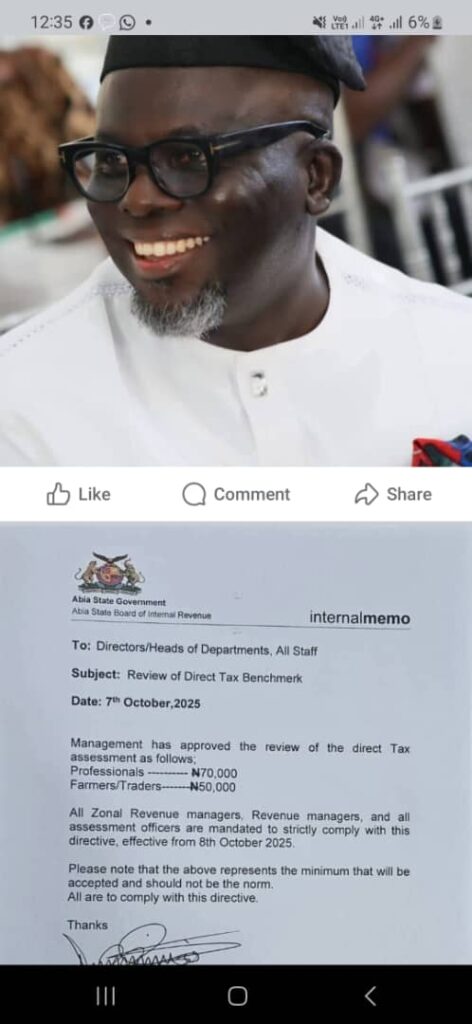
The Abia State Government has dismissed those allegations as false and malicious, insisting that the BIR followed established procedures and acted lawfully at every step. Government spokespeople say Oriaku’s account omits key facts and context that explain why the assessment issued to him was lawful and appropriate. According to the BIR and the state information office, the record shows the following:
The BIR circular that set annual minimum returns for traders at ₦50,000 and for professionals/politically exposed persons (PEPs) at ₦70,000 explicitly described those figures as minimum amounts. Anyone assessed may be asked further questions to determine the correct levy. The government says this circular is publicly available and anyone alleging otherwise should produce evidence.
When a citizen applies for tax clearance, the BIR conducts a routine interview to establish the appropriate tax liability — a standard administrative practice across Nigeria. In Oriaku’s case, BIR staff say they asked him to confirm sources of income and how much he had earned from recent transactions. When he declined to answer, the law allows the Board to perform an administrative assessment (best-of-judgement) to determine the tax due.
The BIR says Oriaku was asked basic questions — for example, what he does for a living and how much he had realised from property sales. According to the government, Oriaku answered inconsistently (reportedly saying he was “jobless” and later saying he was selling properties) and then refused to disclose earnings figures that would enable a precise assessment. On that basis, the Board carried out an administrative assessment and requested payment of ₦483,000.
The government further states that Oriaku subsequently sought a tax clearance in Enugu, where he spoke to a former colleague who is the Enugu BIR chairman. That official allegedly accepted ₦100,000 as a one-off concession because Oriaku said he lacked funds and needed the clearance for a Senate screening — a discretionary gesture, not the result of a formal Abia assessment. The Abia government notes that Enugu’s tax regime is currently higher than Abia’s, and that Oriaku did not inform the Enugu official about the Abia assessment before seeking help there.
The state government has publicly urged Oriaku to publish his 2024 annual income if he maintains that the ₦483,000 assessment was erroneous. Officials say that if Oriaku discloses verifiable income documentation proving the assessment was wrong, the government will apologize and rectify the record. Absent that disclosure, the administration says, Oriaku should withdraw his allegations and apologise to Abians and to BIR staff for the reputational harm caused by what the government describes as a false narrative.
Government spokesmen framed the episode as an attempt by Mr. Oriaku to attract sympathy and public attention by misrepresenting routine tax procedures as politically motivated persecution. The statement warns that politicising administrative tax matters undermines public institutions and distracts from the administration’s priorities of infrastructure renewal, fiscal discipline and service delivery.