

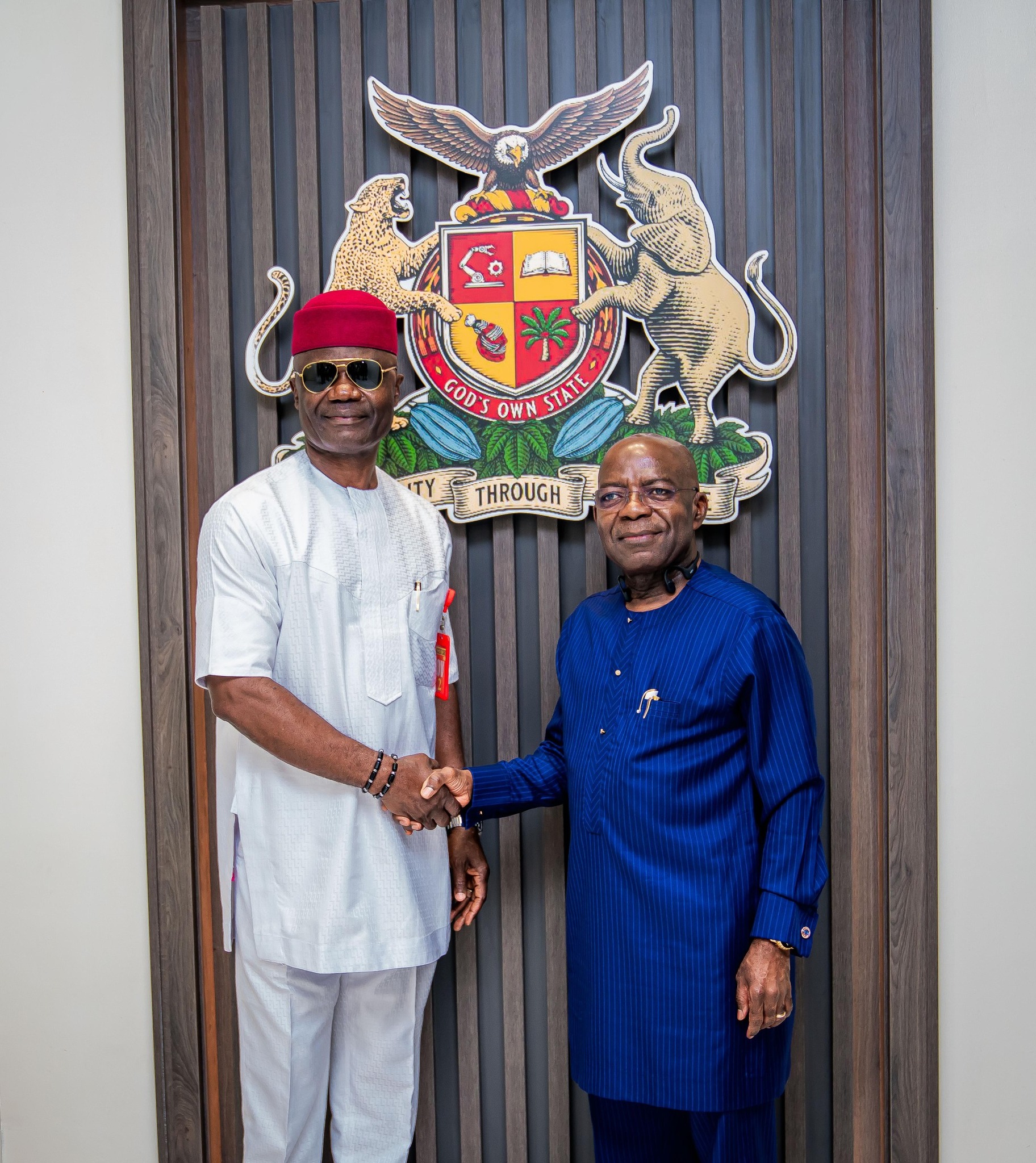
With a blend of gratitude and conviction, Sir Ude Oko Chukwu—immediate past Deputy Governor of Abia State and respected PDP chieftain—has publicly affirmed that Governor Alex Otti’s transformative leadership has more than earned him a second term. Speaking to journalists after a private meeting with Governor Otti, Sir Oko Chukwu painted a vivid portrait of a state revitalized under Otti’s stewardship—one where intentionality and purpose have reshaped every corner of Abia’s social and economic landscape.
Stepping away from the polished corridors of Government House, Sir Oko Chukwu revealed how his travels through Abia North—a region long starved of infrastructural investment—uncovered “unprecedented” road networks. “You see,” he began, “I’ve gone around Abia State, especially those of us who come from Abia North. You just discover that the kind of road infrastructure that we have there is unprecedented.” In his view, this is not mere political posturing or “propaganda.” Rather, it is the unvarnished truth of a leader who has, in barely two years, catalyzed a renaissance of connectivity and commerce.
Yet roadworks are but one thread in Governor Otti’s tapestry of renewal. Sir Oko Chukwu highlighted the Governor’s “very, very intentional” approach to every sector—whether health, education, sports, or environmental management. In health, clinics once neglected now brim with essential equipment; in education, schools are receiving overdue upgrades; and in sports, budding athletes have begun to find facilities worthy of their ambitions. “Going by what he has done so far,” Sir Oko Chukwu insisted, “you will discover that, without mincing words, he has earned himself another tenure.”
The transformation extends beyond concrete and asphalt into the very fabric of daily life. Traversing the commercial nerve center of Aba or the administrative hub of Umuahia, one encounters a level of cleanliness and civic pride previously unseen. “Even if you move around Aba, move around Umuahia,” Sir Oko Chukwu observed, “the level of cleanliness is such that we have not witnessed before.” Litter-strewn streets have given way to tidy avenues; overflowing gutters have been reclaimed as channels of order. This newfound cleanliness, he suggested, is emblematic of an administration that sees beyond short-term fixes to cultivate enduring civic responsibility.
Such sweeping progress has engendered deep appreciation among Abia’s stakeholders—formal and informal alike. According to Sir Oko Chukwu, yesterday’s visit was not a mere courtesy call but “to commend him and to appreciate him, and let him know that all hands are on deck to support him.” From community leaders in the hinterlands to business magnates in Aba, the message is unanimous: Governor Otti’s blueprint for Abia resonates with the hopes of its people.
Still, politics in a vibrant democracy is never static. With the Labour Party gaining momentum in various quarters of the state, talk of “realignments” has swirled among opposition ranks. When asked whether he might shift allegiance to Governor Otti’s new allies, Sir Oko Chukwu offered measured intrigue. “They are doing realignments,” he acknowledged, “and it’s also likely that some of us will join them in doing realignments. If I’m going to do that, I will invite all of you to be part of what will happen, maybe soonest.” Though he stopped short of a firm declaration, the tone conveyed an openness to coalescing around the Governor’s vision.
This political theater, however, is underscored by substance. Sir Oko Chukwu’s vantage point as a former Speaker of the State House of Assembly and Deputy Governor lends weight to his endorsement. He is no casual observer but a veteran of Abia’s political terrain—one uniquely positioned to judge the magnitude of change unfolding under Governor Otti.
In two short years, Governor Alex Otti has demonstrated that governance can be both visionary and pragmatic. His road-building crusade has knit together markets, villages, and urban centers. His investments in health and education have laid the groundwork for a healthier, wiser citizenry. His promotion of sports and cleanliness has rekindled communal pride. And through it all, he has signaled an unwavering commitment to intentional, data-driven policy.
As Sir Ude Oko Chukwu so emphatically put it: “Without mincing words, he has earned himself another tenure.” In the calculus of Abia’s future, this is no idle endorsement. It is the clarion call of a respected elder affirming that, at this crossroads, the path forward lies in continuity—continuity of purpose, continuity of progress, and continuity of the transformative leadership that has begun to reshape the very soul of Abia State.