

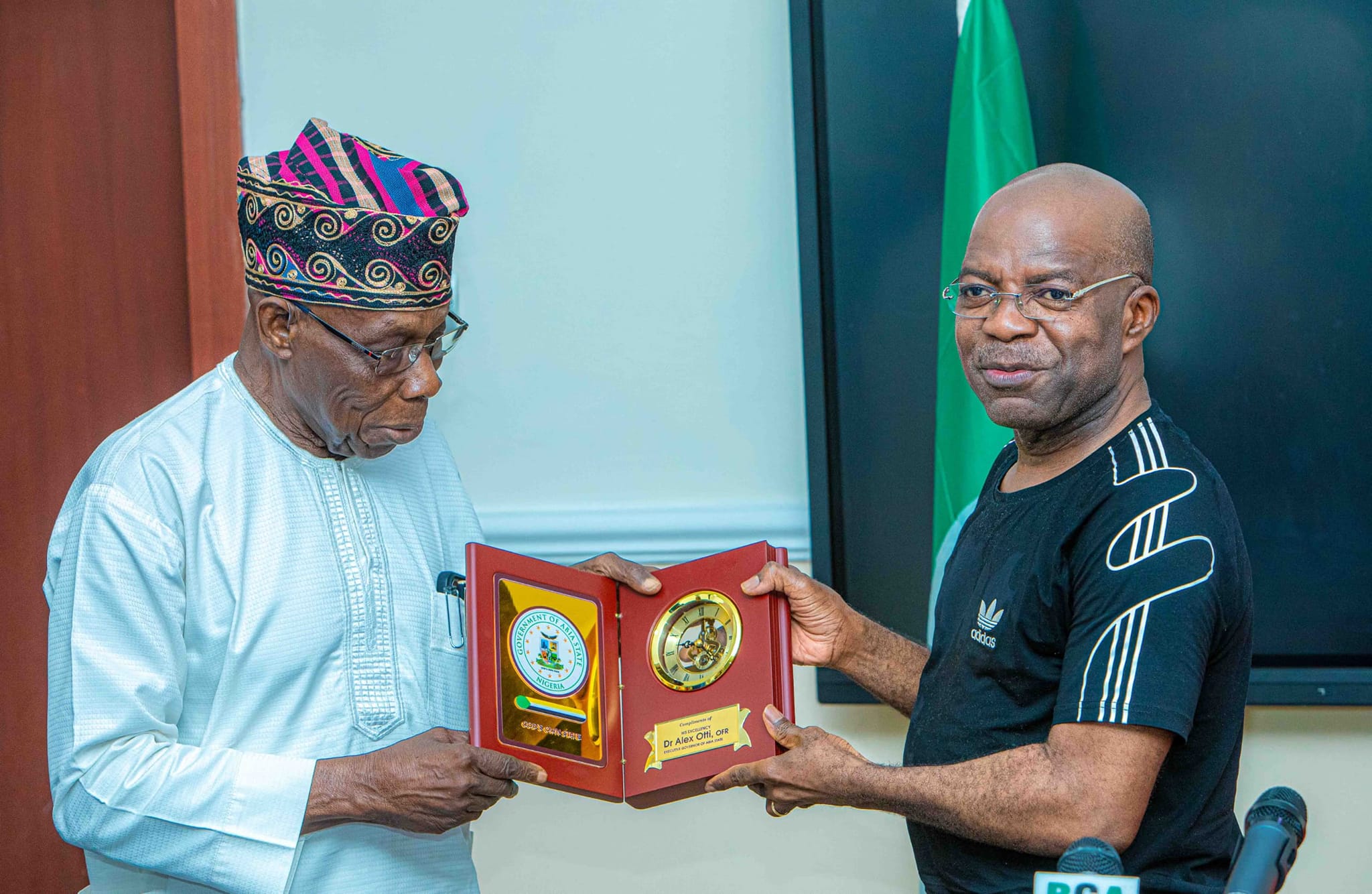
Former President Olusegun Obasanjo’s visit to Abia State was not merely ceremonial; it was a platform for candid discourse and commendation. Stepping into the office of Governor Dr. Alex Otti, OFR, he brought with him not just the weight of his political stature but also his characteristic bluntness. The subject of discussion was Governor Otti’s audacious move to abolish pensions for former Governors and Deputies of the state.
Obasanjo’s commendations weren’t hollow niceties; they were rooted in a deep conviction about the principles of governance. He hailed Otti’s courage in overturning what he termed “rascality” – a law that allowed former leaders to enjoy extravagant obnoxious pensions while ordinary retirees languished without their dues. His words echoed a sentiment of justice long overdue, a departure from the norm of political entitlement.
The former President’s tone carried a mix of admiration and admonition as he addressed Governor Otti. He recounted watching the television broadcast announcing the repeal of Abia’s pension scheme and immediately sought clarity. Otti’s response, according to Obasanjo, reflected a leader willing to confront entrenched injustices and confront them head-on.
Obasanjo’s congratulatory remarks weren’t without an underlying call to action. He challenged Otti’s peers to follow suit, to emulate his courage in dismantling systems of privilege that undermine the essence of public service. His words were a rallying cry for a new breed of leaders committed to genuine stewardship, leaders unafraid to defy convention for the sake of the common good.
Beyond the issue of pensions, Obasanjo’s discourse touched upon the broader responsibilities of leadership. He lauded Otti for his resilience in the face of adversity, emphasizing the importance of physical fitness as a metaphor for the vigor required in governance. In his characteristic style, Obasanjo intertwined personal anecdotes with sage advice, painting a portrait of leadership as a relentless pursuit of progress.
However, amidst the accolades, Obasanjo didn’t shy away from pointing out the arduous path that lay ahead. He reminded Otti that the journey of leadership is fraught with challenges, with detractors ready to pounce at every turn. Yet, he urged him not to falter, to remain steadfast in his commitment to change. For Obasanjo, the transformation of Nigeria’s governance landscape hinged on the perseverance of leaders like Otti.
Infrastructure emerged as a focal point of Obasanjo’s counsel. He implored Otti to prioritize the development of Abia State’s infrastructure, recognizing it as the bedrock upon which progress is built. His words carried a sense of urgency, a reminder that tangible improvements in infrastructure could catalyze economic growth and elevate the standard of living for the people of Abia.
In response, Otti affirmed his administration’s unwavering dedication to infrastructure development, particularly in Aba, the state’s commercial heart. He outlined ongoing projects and future plans, underscoring his commitment to revitalizing critical infrastructure that had long been neglected. His words echoed Obasanjo’s sentiments, reinforcing the belief that infrastructure is not just a matter of convenience but a prerequisite for prosperity.
Beyond infrastructure, Otti expressed gratitude for Obasanjo’s support in abolishing the pension law, reiterating his belief in leadership as stewardship. He emphasized the need for leaders to eschew self-serving practices and prioritize the welfare of the people they serve. His words echoed Obasanjo’s call for a paradigm shift in governance, a departure from the culture of entitlement towards a culture of service.
As the meeting concluded, it was evident that Obasanjo’s visit was more than just a symbolic gesture. It was a rallying cry for change, a testament to the power of courageous leadership in transforming society. In Governor Otti, he saw not just a comrade in arms but a torchbearer for a new era of governance – one defined by integrity, accountability, and a relentless pursuit of progress. And as they bid farewell, the echoes of their conversation lingered, a reminder of the challenges that lie ahead and the promise of a brighter future for Abia State and Nigeria as a whole.