

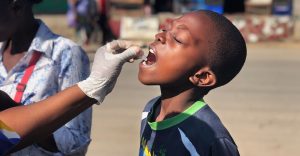
The World Health Organization (WHO) The country’s representative, Walter Mulombo, has said that Nigeria is expected to receive approximately nine million doses of Oral cholera vaccines (OCV).
Mr. Mulombo said this while speaking at the opening ceremony of the Global Task Force on Cholera Control (GTFCC) training on LCO application and campaign planning in Abuja on Monday.
The WHO-organized training aims to integrate LCO into cholera emergency and preventive measures in Nigeria.
Mulombo said that the expected vaccines will ensure the implementation of two campaigns in 14 LGAs in nine states, including the Federal Capital Territory (FCT).
He said this would significantly mitigate the risk of an increase in cholera cases, especially during the rainy season.
He explained that more than 1.7 million people are already vaccinated with two doses of OCV in seven LGAs in four states; Bauchi, Jigawa, Yobe and Zamfara.
He noted that the training of the working group is not only timely but also a good opportunity for everyone to remember the goal of eradicating cholera.
“We are calling on all member states to adopt the One Health approach to responding to cholera outbreaks,” he said.
Participants at the opening ceremony of the Global Task Force on Cholera Control (GTFCC) training on oral cholera vaccine application and campaign planning in Abuja on Monday. Endemic in Nigeria
Cholera is an acute diarrheal infection caused by ingestion of food or water contaminated with the Vibrio cholera bacterium.
It appears periodically in countries that cannot ensure access to clean drinking water and adequate sanitation such as Nigeria.
Although it is a preventable and treatable disease, the number of cholera cases tends to increase with the start of the rainy season.
Molumbo said Nigeria has downgraded its largest cholera outbreak that began in 2021 with more than 100,000 suspected cases reported.
In 2021 alone, Nigeria lost no fewer than 3,604 people to cholera, according to data from the Nigerian Center for Disease Control (NCDC).
Early Vaccine Assignment
Mr. Mulombo reiterated the need for prompt allocation and shipment of these vaccines to ensure that the vaccines are timely.
He advised that all opportunities for vaccination campaigns be used to specifically target areas with huge zero doses and ensure that those children who are often missed are not only offered OCVs, but also opportunities for all routine vaccinations.
He said some challenges identified during the 2021 GTFCC Annual Stakeholders Meeting include requests for low-quality reactive and preventive OCV campaigns, lack of use of OCVs as outbreak response in some settings, and inadequate monitoring and evaluation of OCV campaigns. OCV.
He said that all these challenges need to be addressed urgently for countries to win the fight against cholera.
“We are confident that the opportunity of this training will not only help to improve the gaps identified, but will also ensure that countries are better prepared to request, plan and implement quality campaigns with LCOs as part of their national cholera control plans and further contribute to the long-term goal of ending cholera by 2030,” he said.
Participants at the opening ceremony of the Global Task Force on Cholera Control (GTFCC) training on oral cholera vaccine application and campaign planning in Abuja on Monday. Adoption of OCV for prevention, control
In his remarks, Nigerian Health Minister Osagie Ehanire praised the WHO for what he described as a laudable and desirable initiative.
Mr. Ehanire described LCO as a tool for the prevention and control of cholera outbreaks, “which has become a recurring seasonal public health challenge in many low- and lower-middle-income countries, such as ours, through despite control efforts.
He said the traditional measures for cholera prevention and control have been to provide clean water and improve hygiene and sanitation.
He said that the OCV is an additional tool in the fight against cholera outbreaks in the country.
“Over the years, the science has been up to the task, with the development of OCV, now certified as effective enough to be recommended for disease prevention and control,” he said.
However, Ehanire lamented the limited doses of cholera vaccine in the country. She said this had restricted its use and long-awaited impact.
“Therefore, I welcome this training as a prelude to equitable access to this vaccine and another step toward our goal of better health for all.
“I think it will strengthen our health system by reducing, or even eliminating, one more public health nuisance through vaccination,” he said.
Malika Bouhenia, a member of the working group, said that the use of the cholera vaccine is important and has a great impact on the control of the disease.
Ms. Bouhenia said that since the creation of the vaccine, its use has continued to increase in several countries.
However, he said the task force must identify its use to completely eradicate cholera by 2030.