

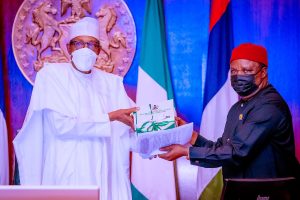
President Muhammadu Buhari says he will await the outcome of the constitutional review process before submitting the report of the vertical revenue allocation formula review to the National Assembly as a bill for enactment.
This was stated by the president on Thursday in Abuja upon receiving the report of the Revenue Mobilization Allocation and Fiscal Commission (RMAFC), led by Elias Mbam.
“Normally, I would have gone ahead to present this report to the National Assembly as a bill for enactment.
“However, since the review of the vertical revenue allocation formula is a function of the roles and responsibilities of the different levels of government, I will await the outcome of the constitutional review process, especially as some of the proposed amendments would be related to the recommendations contained herein,” he said.
President Buhari listed some of the report’s recommendations as follows:
”Establish local government as a level of government and the associated repeal of the state/local government account; airport transfer; fingerprints, identification and criminal records from the exclusive legislative list to the concurrent legislative list, empowering the RMAFC to demand compliance with the remission of accumulations and the disbursement of income from the Federation Account, as well as streamline the procedure to review the revenue allocation formula.’ ‘
President Muhammadu Buhari received a briefing on the revision of the vertical revenue allocation formula from members of the Revenue Mobilization, Allocation and Fiscal Commission (RMAFC) at the State House, Abuja.
The President assured the members of the Commission that the Federal Government would immediately submit the report to its internal review and approval processes while awaiting the completion of the efforts by the National Assembly.
According to the President, this strategy, rather than issuing an Executive Modification order, as was done in 1992, is more in line with the consolidation of our democratic principles.
He commended the RMAFC for a job meticulously done, pledging his unwavering commitment and support in fulfilling its constitutional mandates.
The President also thanked Nigerians, especially state and local governments, for providing input through the extensive stakeholder engagement processes that produced the report.
His words:
”I am aware that the current revenue allocation formula has not been revised since the last exercise in 1992.
”Considering the changing dynamics of our political economy, such as privatization, deregulation, the financing arrangement of primary education, primary health care, and the growing clamor for decentralization, among others; we need to take another look at our revenue sharing formula, especially the vertical aspects that relate to levels of government.
“This becomes more compelling as we need to reduce our infrastructure deficit, make more resources available to address insecurity, confront climate change and its associated global warming, and make life more meaningful for our rapidly growing population.” .
President Muhammadu Buhari received a briefing on the revision of the vertical revenue allocation formula from members of the Revenue Mobilization, Allocation and Fiscal Commission (RMAFC) at the State House, Abuja.
President Buhari said that as an advocate of grassroots development, he has always been committed to ensuring that all levels of government receive fair, equal and equitable treatment in the sharing of national resources.
”I want everyone to know that I have followed most of the discussions in the geopolitical consultative process closely and one thing that struck me was the agreement that a revision of our vertical revenue formula cannot and should not be a emotional or sentimental theme. discussion and cannot be done arbitrarily.
“All over the world, the allocation of income and resources has always been a function of the level of responsibilities assigned to the different components or levels of government.
“Thus, I am pleased to note that the discussions took place in this way and were directly based on the roles and responsibilities laid out in the 1999 (as amended) Constitution.
“However, I also note that in reaching the final decisions on most of these compromises, not much emphasis was placed on the fact that the Second Schedule to the Nigerian constitution contains Sixty-Eight (68) articles on the Legislative List Exclusive and the rest Thirty (30) items on the Concurrent List that require both the federal and state governments to address.”
President Buhari therefore stated that for the nation to have a lasting review of the current revenue allocation formula, there must first be an agreement on the responsibilities to be carried out by all levels of government.
In particular, he pointed out that the proposal seeks a reduction of 3.33% in the current allocation of the Federal Government and, on the other hand, an increase of 3.07% and .44% for the States and Local Governments on the other hand.
He added that regarding the Special Funds, the RMAFC report proposed an increase of .2% for the Federal Capital Territory (FCT) and a decrease of .38% for the Development of Natural Resources.
The President reported that the Federal Government also made its contribution to the review process of the formula for vertical allocation of income based on the existing constitutional provisions for the functions and responsibilities of the different levels of government.
advertisements
ALSO READ: RMAFC begins review of revenue allocation formula
”We must note the growing visibility in the responsibilities of the subnational level due to the weaknesses at that level, for example, Primary Health Care; Primary Basic Education; levels of insecurity, and; Increase in remittances to State and Local Governments through the Value Added Tax participation formula, where the Federal Government has only 15% and the States and Local Governments share 50% and 35% respectively” , said.
President Muhammadu Buhari received a briefing on the revision of the vertical revenue allocation formula from members of the Revenue Mobilization, Allocation and Fiscal Commission (RMAFC) at the State House, Abuja.
In his remarks, the Federation Government Secretary, Boss Mustapha, said that the RMAFC followed due process in conducting the exercise and sought the opinion of the Federal Government before finalizing the report.
Giving a synopsis of the report, Mr. Mustapha said that it was in four volumes, including a summary in the main report.
”Volume 1 contains the various memorandums submitted by the federal and state governments, as well as the FCT. Volume 2 details the presentation of academia, civil society, professional bodies, traditional rulers, individuals, as well as women and youth council.
”To complete the inclusiveness of the adopted stakeholder engagement processes, Volume 3 is an investigation capturing the body of knowledge that underpinned the review, while Volume 4 is a further distillation of state government submissions and local, as well as from NGOs and area councils. of the FCT,” he said.
Also speaking, Mr Mbam said the main philosophy behind the proposed revision was guided “by the need for distributive justice, fairness and equity enshrined in the relevant sections of the 1999 (as amended) Constitution”.
He added that the principles took into account the indivisibility of the country, public opinion and weighed the responsibilities and constitutional functions of the three levels of government.
He announced that the proposed vertical revenue allocation formula advised 45.17 percent for the Federal Government, 29.79 percent for State Governments and 21.04 percent for Local Governments.
Under Special Funds, he said, the Commission Report recommends 1.0 percent for Ecology, 0.5 percent for Stabilization, 1.3 percent for Natural Resources Development, and 1.2 percent for FCT.
In arriving at the new vertical revenue allocation formula, Mr. Mbam told the president the commission had extensive consultation with key stakeholders, public hearings across geopolitical zones, administered questionnaires and studied some other federations with arrangements. Similar prosecutors like Nigeria to extract useful information. lessons from his experiences.
According to the RMAFC chair, the Commission also visited all 36 states and the FCT, all 774 local government areas to raise awareness and gain input from stakeholders.
He added that literature reviews were conducted on the revenue allocation formula in Nigeria dating back to the pre-independence period, while the Commission received memos from public sectors, individuals and private institutions across the country.
Explaining the main reasons for the exercise, Mr. Mbam pointed out that since the last review was carried out in 1992, 29 years ago, the political structure of the country has changed with the creation of six additional States in 1996, which raised the number of States to 36.
Consequently, he said, the number of local government councils also increased from 589 to 774.
“There have been considerable changes stemming from political reforms that have altered the relative share of responsibilities at different levels of government, such as deregulation, privatization, and ongoing disputes over the financing of primary education and primary health care.” ‘, said.
The RMAFC President noted that while Section 32(b), Part 1 of the Third Schedule to the 1999 Constitution 9 (as amended) empowers the Commission to periodically review revenue allocation formulas; inadequate and deteriorating infrastructure, as well as increased internal security challenges pervasive throughout the country also necessitated the exercise, among others.
female killer
Special Advisor to the President
(Media and advertising)
April 7, 2022