

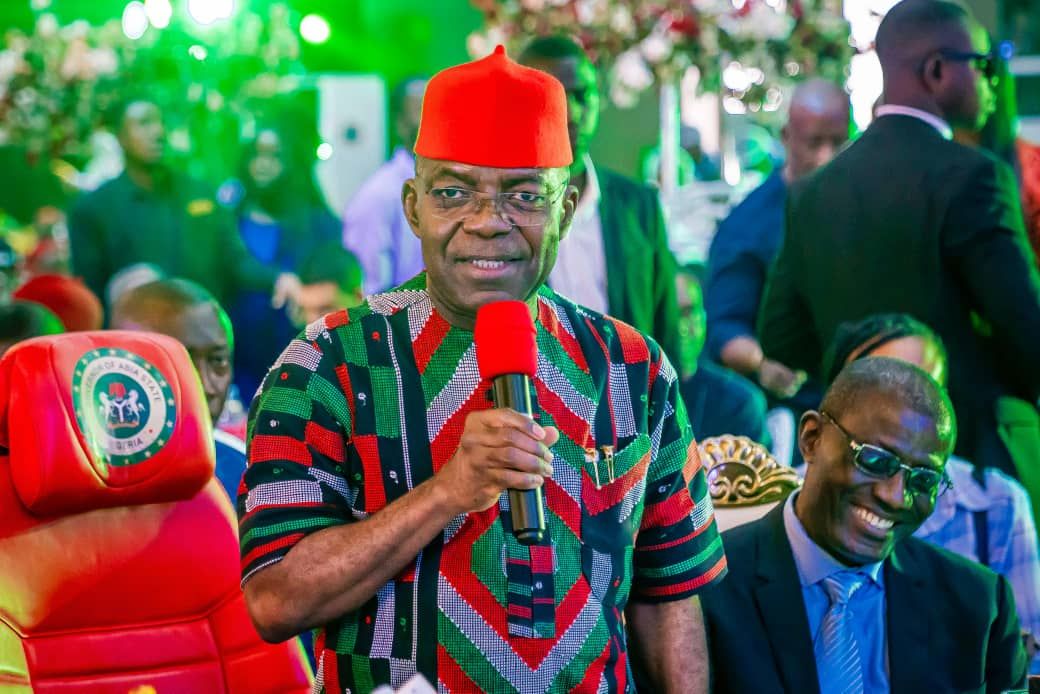
Under the high-domed ceiling of the International Conference Centre in Umuahia on Thursday, July 10, 2025, history quietly unfolded. Dr. Alex Chioma Otti, OFR—the indefatigable Governor of Abia State—sat at the helm of a gathering unlike any before. Around him were some of Nigeria’s most influential figures, each united by a single, urgent purpose: to forge a Security Trust Fund that would marshal billions of Naira in support of the state’s security agencies.
From the moment guests arrived—the venerable Chief Arthur Eze, Eze N’Ikpo, whose philanthropy has sustained countless public causes, to Chief Deji Adeleke, father of global music star Davido—there was an unmistakable air of determination. Chief Innocent Chukwuma, CEO of Innoson Motors; Architect Dr. Kaycee Orji of Roxettes Motors; Professor Barth Nnaji of Geometric Power; legal luminaries like Chief Ken Ahia, SAN; and a host of captains of industry, traditional rulers, and civic leaders filled the hall. Corporate partners—banks and businesses intertwined with state projects—stood shoulder to shoulder with private citizens, each ready to commit resources to strengthen Abia’s security architecture.
It was, in Governor Otti’s words, a “public–private partnership initiative designed to mobilize resources from both government and non-governmental stakeholders to enhance the operational capabilities of security agencies within the State.” His vision was precise: logistics, state-of-the-art equipment, advanced communication tools, and robust surveillance infrastructure, all poised to empower security forces to respond to threats in real time.
The Governor rose to welcome his allies, his measured voice resonating through the chamber. He spoke of the greater Abia family—every resident a stakeholder in the safety and prosperity of their homeland. “Security,” he reminded them, “is not the province of government alone. It is an entire community’s enterprise.” His appeal was simple yet profound: if the state had declared an emergency on insecurity at the outset of his administration, it was because safeguarding lives and property was both a moral imperative and the bedrock of economic renewal.
Indeed, Otti’s security strategy has already yielded concrete results. When he assumed office, pockets of Abia—particularly in Umunneochi and Isuikwuato—were effectively “no-go” zones. Through his establishment of “Operation Crush” and the provision of armored personnel carriers, UAVs, and cutting-edge surveillance technologies, those enclaves have been reclaimed. Where once fear discouraged investment, now a renewed confidence has drawn unions, associations, and conferences to the state. Small businesses, too, have flourished on the back of safer streets.
By the close of the luncheon, more than ₦3.4 billion had been pledged. It was a testament to the Governor’s capacity to inspire—and to the deep well of goodwill he has cultivated. But beyond the total, the occasion carried symbolic heft: the first public invocation of the Abia State Security Trust Fund Law of 2024. That legislation carved out a dedicated framework for collecting, managing, and deploying funds specifically earmarked for security enhancement. Today’s gathering was the law in action, its potential unleashed by Otti’s political will.
As donations were announced, there were stirring moments. Chief Festus Oshaba Onuh of Ferotex Construction stood and declared his company’s substantial commitment. Chief Leslie Ebueme Ezikpe of Goldrusch Limited spoke of his belief that peace is the currency of development. And Eze Linus Mbah, Chairman of the State Council of Traditional Rulers, invoked ancestral duty: “We are guardians of our people,” he intoned, “and today we answer that call.”
Yet Governor Otti was careful to tether celebration to accountability. He reminded the gathering that “every kobo raised will be judiciously applied,” holding aloft the Administration’s 25‑month record of prudent resource management. He pledged transparent reporting and periodic audits, thereby inviting civil society and the press to join in oversight. His assurance was as firm as his handshake: the Trust Fund would deliver results, and Abians would see tangible improvements on the ground.
The launch reverberated beyond the walls of the conference centre. In the hours that followed, social media abounded with praise for Otti’s foresight. Analysts noted that by enshrining a collaborative funding mechanism, he had created a model other states might emulate. Abia’s rising profile as a secure, investor‑friendly destination owes much to that foresight—and to the practical steps of equipping security personnel with the tools they need.
Still, the Governor reminded all that the battle against crime is far from over. “Security,” he cautioned, “is an evolving challenge. We must remain vigilant.” He called on residents to report suspicious activity and to take “a passing interest” in their communities. “We are each a guardian,” he concluded, “and when one of us sleeps while another stands watch, our watch falters.”
As evening fell over Umuahia, the gathering dispersed with a renewed sense of purpose. Bills were signed, pledges recorded, and handshakes exchanged—but the true work lay ahead. Logistics would be arranged; equipment procured; partnerships formalized. In the weeks and months to come, Abia’s security agencies will bear the fruits of this monumental effort.
And so, history was made not in a single grand gesture, but in collective resolve. Under Governor Alex Otti’s leadership, Abia State has demonstrated that tackling insecurity is neither the sole burden of government nor an insurmountable obstacle. Rather, it is a shared mission—one that, when embraced by public servants, business leaders, traditional institutions, and citizens alike, can transform a state. The Security Trust Fund stands as both symbol and solution: a step in the right direction, driven by the conviction that no price is too high to protect lives, livelihoods, and the bright future of Abia.